
Shingle Nailing Before Fall Wind: Why Modesto Courses Need Proper Fasteners
Fall wind tests how asphalt shingles are fastened, not only how they look from the street. Here is why nail placement and course fastening matter for Modesto and Central Valley roofs.
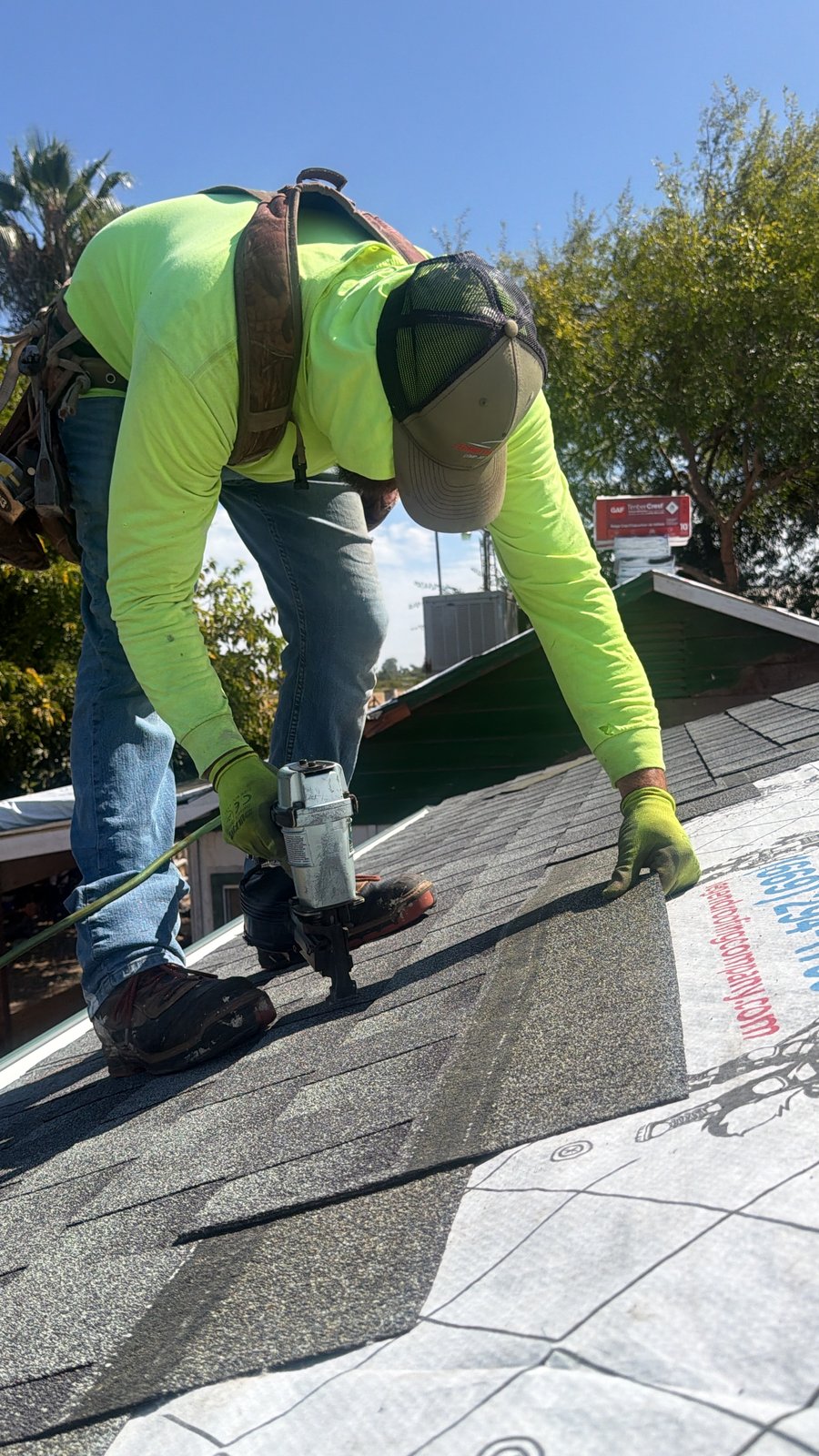
Proper course fastening starts on dry underlayment — nailer on the fastening line, shingle held true, Legend public phone kept on the branded underlayment.
After a long Central Valley dry season, Modesto homeowners usually watch for heat damage, curled edges, and the first soft spots. Fall wind adds another test: how the asphalt courses are fastened. A shingle that looks fine from the yard can still lift, tear, or open a path for rain if nails missed the fastening line, sat too high, or never sealed the course the way the manufacturer designed.
This guide is for homeowners in Modesto, Ceres, Riverbank, Oakdale, Turlock, Ripon, and nearby Central Valley towns. It stays distinct from Central Valley heat and asphalt shingles (summer aging), drip edge before fall rain (edge metal), ice and water shield at eaves (self-adhered perimeter membrane), and soft spots / roof decking (the wood under the surface). Here the focus is the fastener craft that keeps architectural courses seated when fall wind arrives.
What “proper nailing” actually means
Architectural asphalt shingles are designed with a fastening zone — a band where nails (or approved fasteners) should land so the course holds through wind and the next course covers the heads. Manufacturer instructions set nail count, placement relative to the seal strip and cutouts, and whether hand-nail or pneumatic nailers are allowed on that product line.
Homeowners often confuse nailing problems with:
- Heat and UV aging — granules and seal strips cooked by summer sun (Central Valley Heat & Asphalt Shingles)
- Missing drip edge or tired edge metal — perimeter metal that guides water off the deck (Drip Edge Before Fall Rain)
- Thin backup at eaves — ice-and-water / leak barrier under the first courses (Ice & Water Shield Before Fall Rain)
- Underlayment age alone — the backup sheet across the field (What’s Under Your Shingles?)
- Ridge-cap finish — the peak course that closes the top (Ridge Caps on a Modesto Roof Replacement)
For material context, see the materials hub and Roofing Modesto.
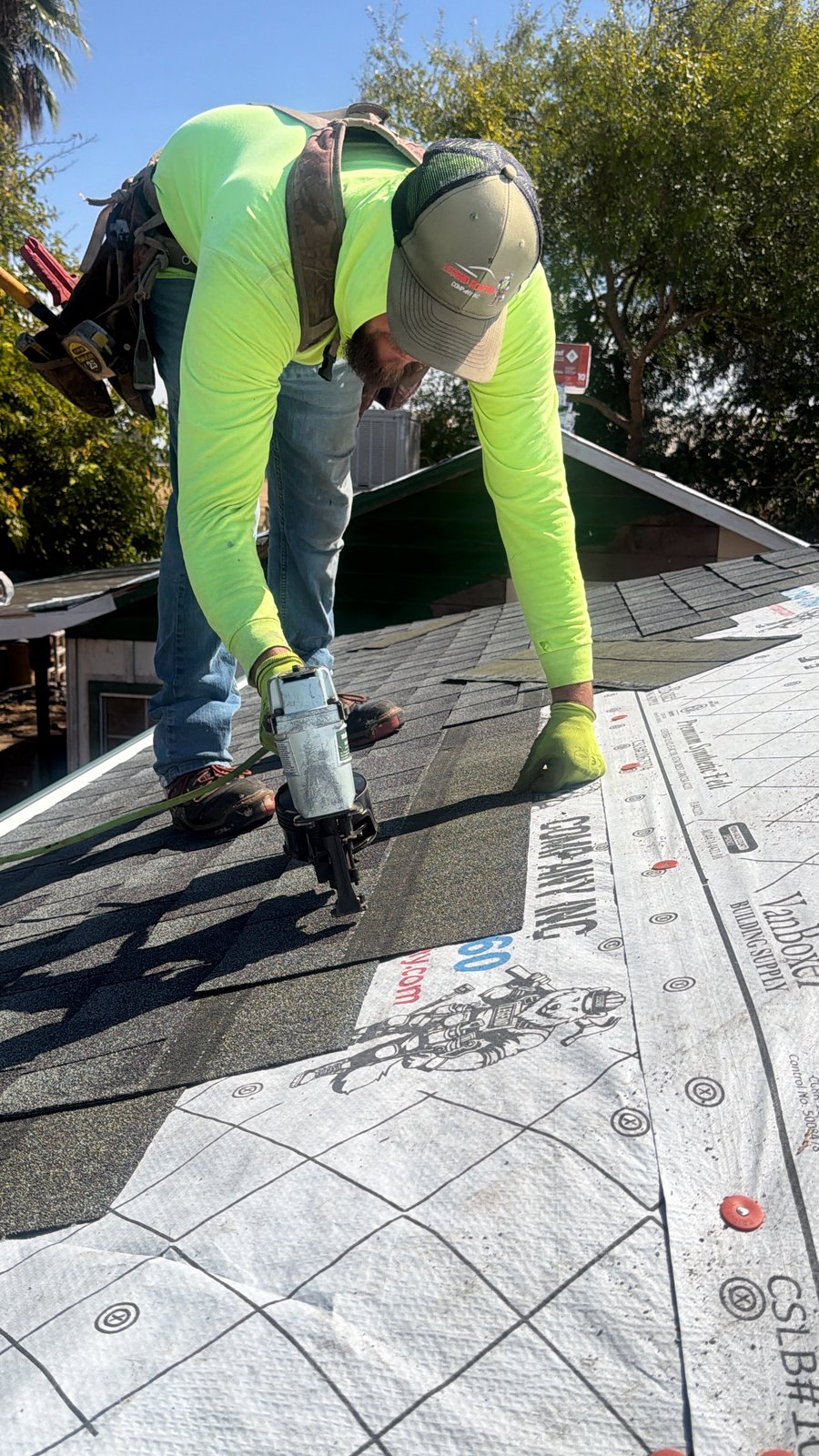
Wind readiness is nail placement — fasteners into the manufacturer fastening zone over sound underlayment, not random hits through the weather face.
Why fall wind cares about fasteners in the Central Valley
Central Valley summers leave months with little meaningful rain. Shingle seal strips and adhesive strips see heat and dust. When the first real storms return to Modesto, Oakdale, Ceres, or Riverbank, wind-driven rain does not only hit eaves and valleys — it also pries at course edges. Fasteners that landed too high, too few, or outside the fastening zone give wind a better lift.
Proper nailing is not a marketing slogan. On a documented Legend Oakdale install, that looks like a crew member with a pneumatic nailer seating dark cool-roof architectural courses (GAF Timberline HDZ RS Coastal Slate) over Legend-branded synthetic underlayment — public phone and website printed on the underlayment, fastener targets visible, courses held true before the gun fires.
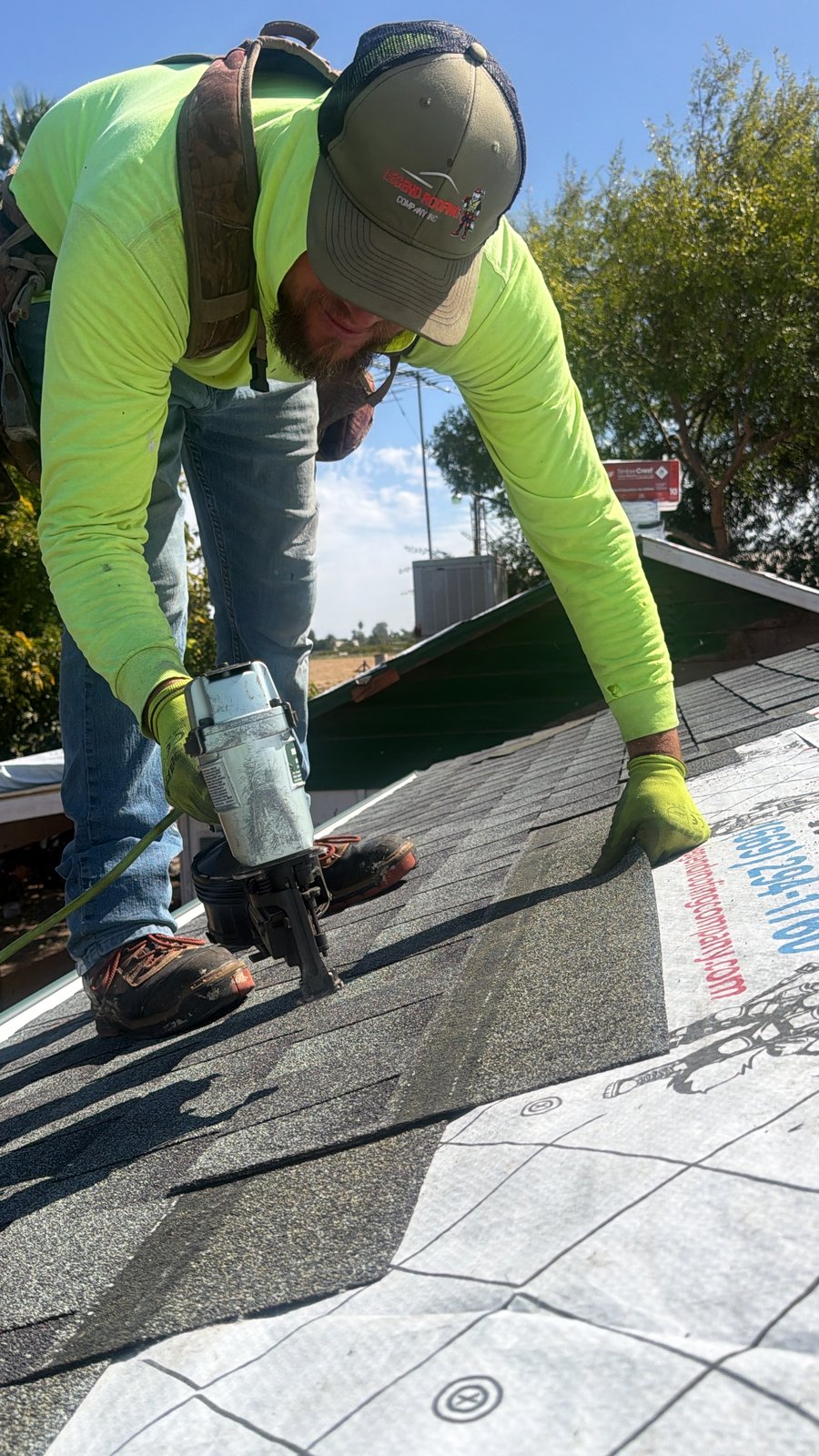
Same Oakdale Coastal Slate install from a craft portrait angle — Legend branding on cap and underlayment, public phone kept.
What a wind-ready course looks like mid-job
A careful asphalt install is a sequence:
- Solid deck and dry underlayment — synthetic underlayment fastened with plastic-cap nails where specified; edge membrane and drip details already in the stack where the perimeter needs them
- Starter and first courses — starter strip and first weather courses set so the seal pattern can do its job
- Field courses with correct nail placement — nails in the fastening zone, correct count per shingle, heads snug (not underdriven into soft wood, not overdriven through the mat)
- Ridge and penetrations — ridge caps and flashings close the system (ridge-cap guide)
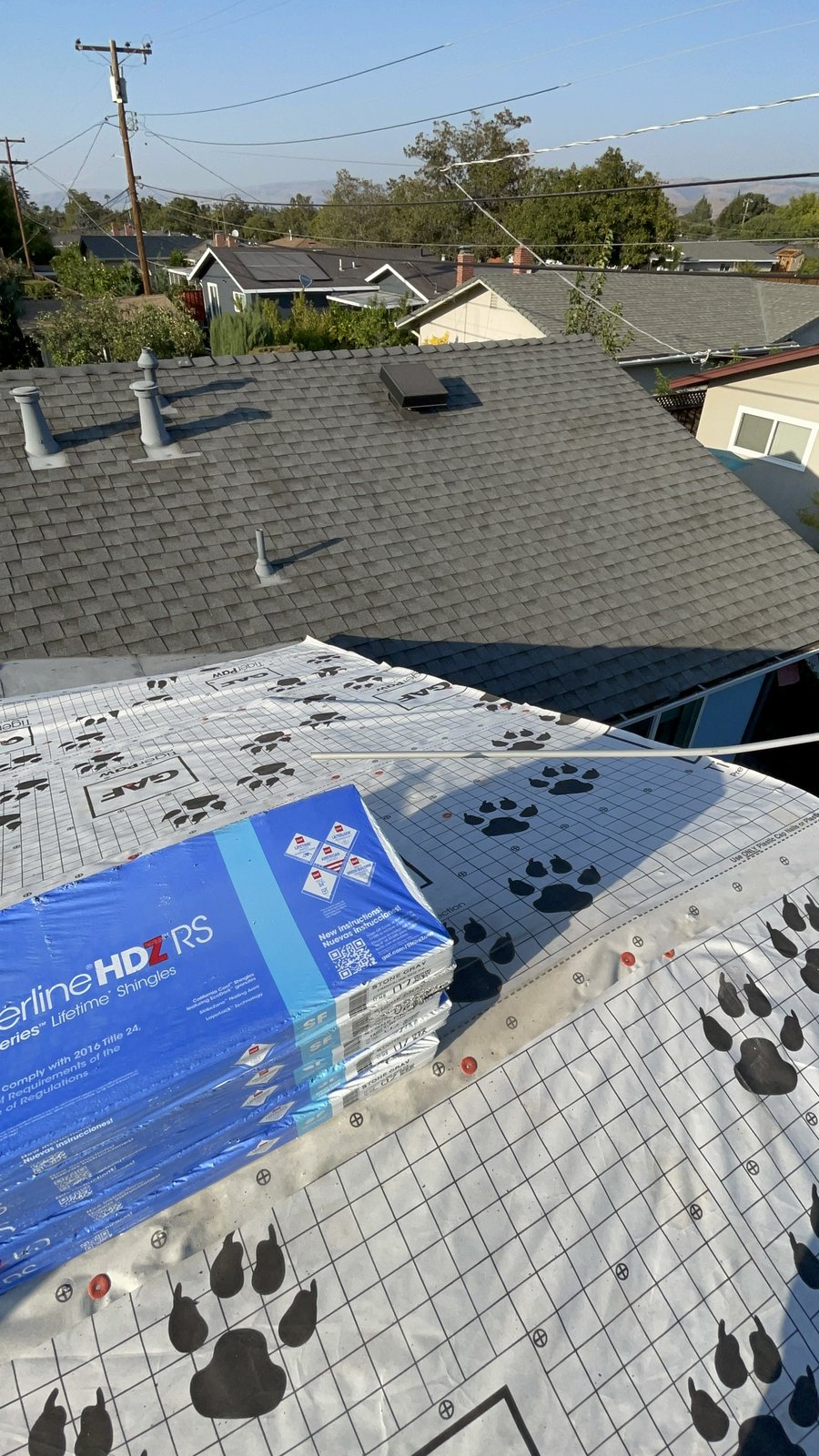
Before courses get nailed, underlayment is fastened and bundles are staged — the fastening layer has to be ready before wind-facing shingles go down.
On an Oakdale craft shot from a lower angle, you can see the nailer on the course, red plastic-cap nails in the underlayment, and printed targets on the synthetic sheet — structure and backup first, then fasteners into the shingle fastening line.
What homeowners can safely notice from the ground
Stay off a wet, steep, or windy roof unless you are trained and insured. From the yard, binoculars, attic (where safe), or clear contractor photos, useful cues include:
- Lifted or creased tabs after a wind event, especially on exposed slopes
- Missing or hanging shingles with fasteners still in the deck (or empty holes where nails pulled)
- Nail heads visible below the weather face (overdriven or misplaced) when a course is opened for repair
- Uneven courses or buckles that suggest the field was rushed
- Interior stains under the same slope after wind-driven rain
You usually cannot count nails from the street once the roof is finished. Ask for mid-job photos of the fastening line and underlayment when a replacement or repair is underway — before the next course covers the heads.
Before the first fall storms: a practical checklist
- Note any prior wind events that lifted tabs or scattered granules on exposed slopes
- Ask whether the product install follows the manufacturer fastening pattern (nail count and zone) — not a generic “we nail everything the same” answer
- Ask for photos of underlayment and course fastening mid-job when a replacement is open
- Confirm edge details (drip edge, ice-and-water at eaves, starter) are in the same scope conversation — not fasteners alone
- Use Get a Quick Quote or call if you want Legend Roofing Company Inc to document fastening concerns in clear photos and plain language
Soft next step
Questions about asphalt shingle nailing or wind readiness on a Modesto, Ceres, Riverbank, Oakdale, Turlock, or Ripon home? Get a Quick Quote via Contact or call (669) 294-1760. Legend Roofing Company Inc — 4400 Gomes Rd, Modesto, CA 95357 — CSLB #1067374 — GAF Master Elite. More local context: Roofing Modesto. Appointments available daily 7am–5pm.