
Standing Seam Metal Before Fall: When Modesto Homes Choose Metal
Standing seam is a full roof system—not a trim detail. Here is when Modesto and Central Valley homes choose metal, how dry-in and penetrations work, and what homeowners can safely notice before fall.
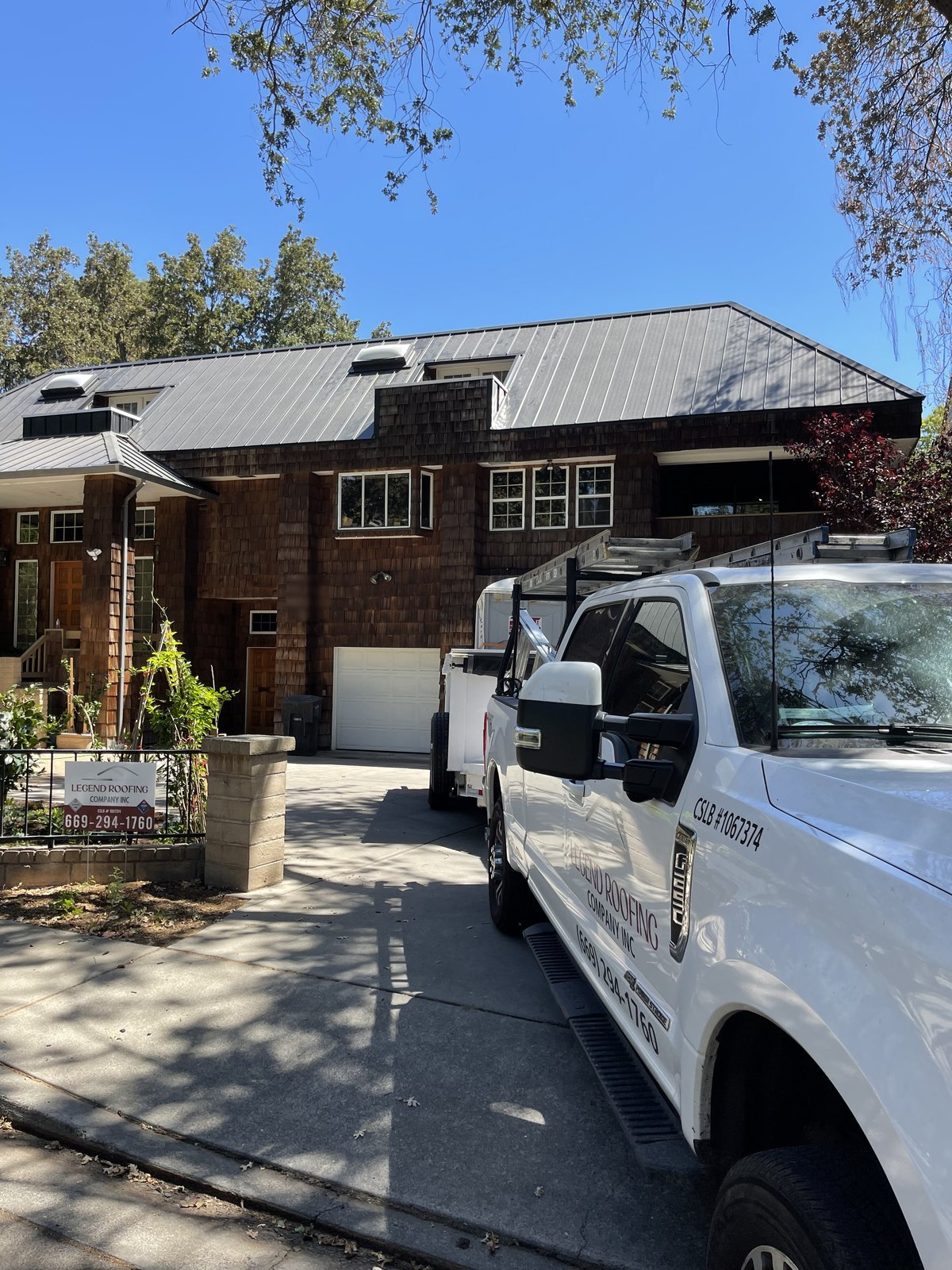
Finished charcoal standing seam metal with skylightsLegend truck and yard sign show (669) 294-1760 and CSLB #1067374.
After a long Central Valley summer, Modesto homeowners often ask about metal the same way they ask about vents or eaves: Will this last the next decade of heat?” Standing seam is not a strip of drip-edge trim and it is not ice-and-water membrane. It is a roof system—panels locked along raised seams, dry-in underlayment underneath, and careful flashing at every skylight, pipe, and wall.
This guide is for homeowners in Modesto, Ceres, Riverbank, Oakdale, and nearby Central Valley towns who want honest metal education before cooler, damper nights return. It is distinct from attic roof vents, ice-and-water at eaves, and valley metal detailing.
When metal makes sense in Central Valley heat
Central Valley summers push roof surfaces hard. Dark asphalt fields absorb heat; metal reflects more of the suns energy depending on color and finish, and standing seam panels do not rely on asphalt granules that can age in 100°F+ stretches. That does not mean every home “must” go metal. Metal often makes sense when a homeowner wants a longer service life on a primary plane, when a porch or low-slope bump-out needs a panel product that sheds water cleanly, or when heat aging on existing asphalt is already part of the conversationsee What Central Valley Heat Does to Asphalt Shingles.
Metal is a system choice, not a sticker upgrade. Color, panel profile, and fastening method all matter for local wind, thermal movement, and appearance next to wood shakes, stucco, or lap siding.
Standing seam basics (what you are actually buying)
Standing seam means long metal panels that meet at raised vertical ribs (the “standing seams). Panels typically run from eave toward ridge. Seams may be mechanically locked or snap-locked depending on the product line. The weather surface is the metal itselfnot a granule field.
What homeowners often confuse with standing seam: drip edge / eave metal (edge trim, not a full metal roof), valley metal (a flashing channel between slopes), and exposed-fastener or corrugated panels (screws through the panel face—different products). For material context, see Metal Roofing, the materials hub, and Metal Sales.
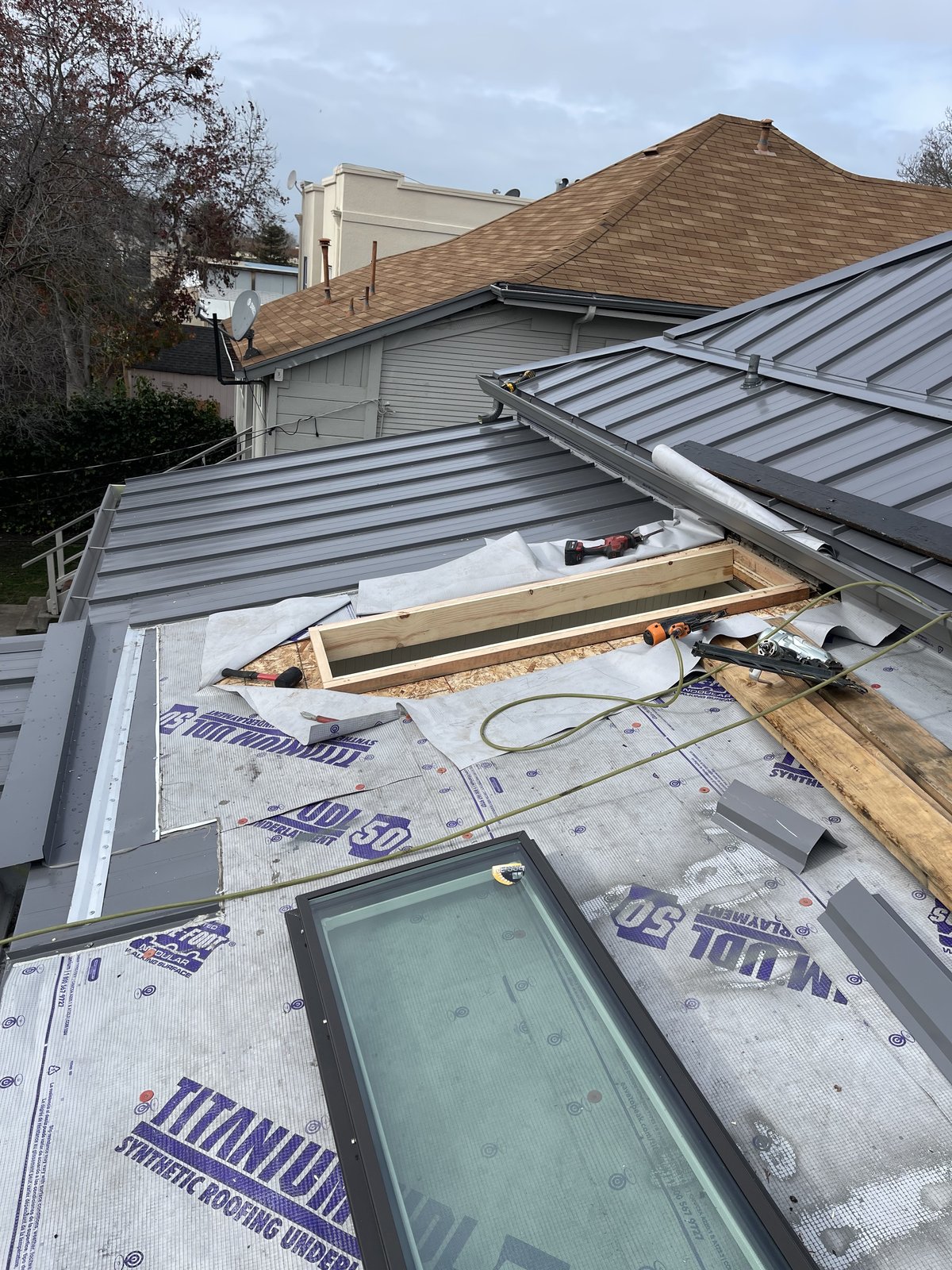
Metal dry-in in progressTitanium UDL underlayment, an open skylight curb, and charcoal standing seam already on adjacent planes.
Underlayment and dry-in under metal
Metal panels are the visible weather surface. Underneath, a dry-in layer still matters: synthetic underlayment (products like Titanium UDL appear on real Legend jobs) covers the deck before panels go down. That layer sheds incidental water during install and remains a secondary barrier if wind-driven rain ever finds a seam or penetration.
Dry-in is not optional “extra paper.” It is part of how a metal system is staged on a residential deck—especially when adjacent planes still show asphalt, or when skylight curbs are open mid-job. For the broader underlayment story, see What's Under Your Shingles?.
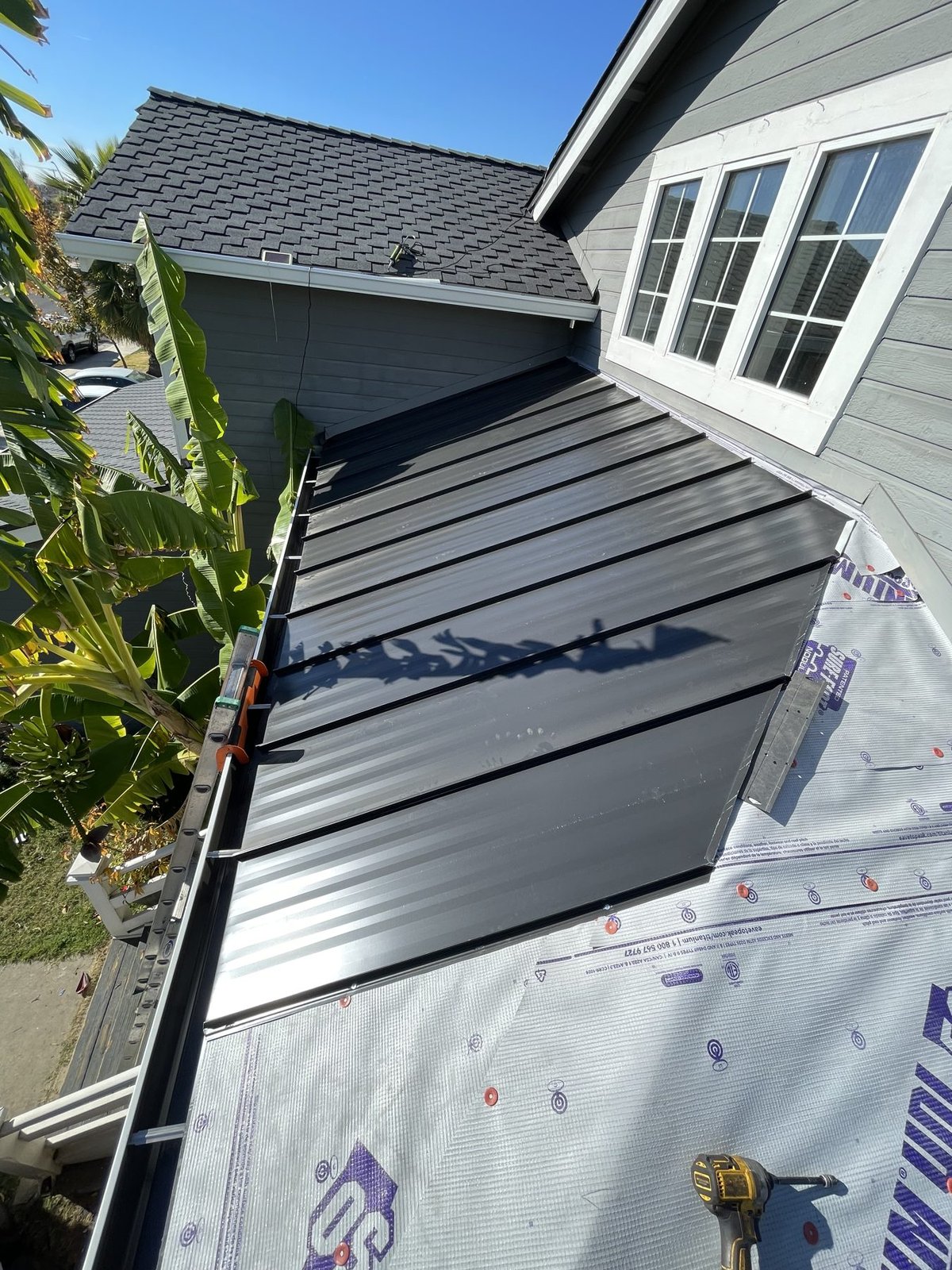
Standing seam going down over synthetic underlayment—often as a porch or bump-out accent under an asphalt main field.
Skylights and penetrations on metal
A finished charcoal standing seam field often includes skylights. On metal, a skylight needs a curb or manufacturer-matched flashing package that integrates with the panel layout—not a blob of sealant on a cut panel. Mid-job photos commonly show synthetic underlayment around an open curb, adjacent planes already in standing seam, and trim waiting for the curb to close into the metal field.
Pipes, vents, and wall transitions follow the same rule: flash to the system, then finish panels so water sheds past the penetration. That is a different craft sequence than asphalt pipe boots, even though the homeowner goal is the same—keep water out.
Asphalt main field + metal accents
Not every Modesto metal conversation is a full tear-off to standing seam. Many homes keep architectural asphalt on the main field and use standing seam on a porch, entry, or lower bump-out. From the street or a careful aerial, you see two products sharing one house: shingles above, charcoal metal on the accent plane, underlayment visible while the accent is mid-install.
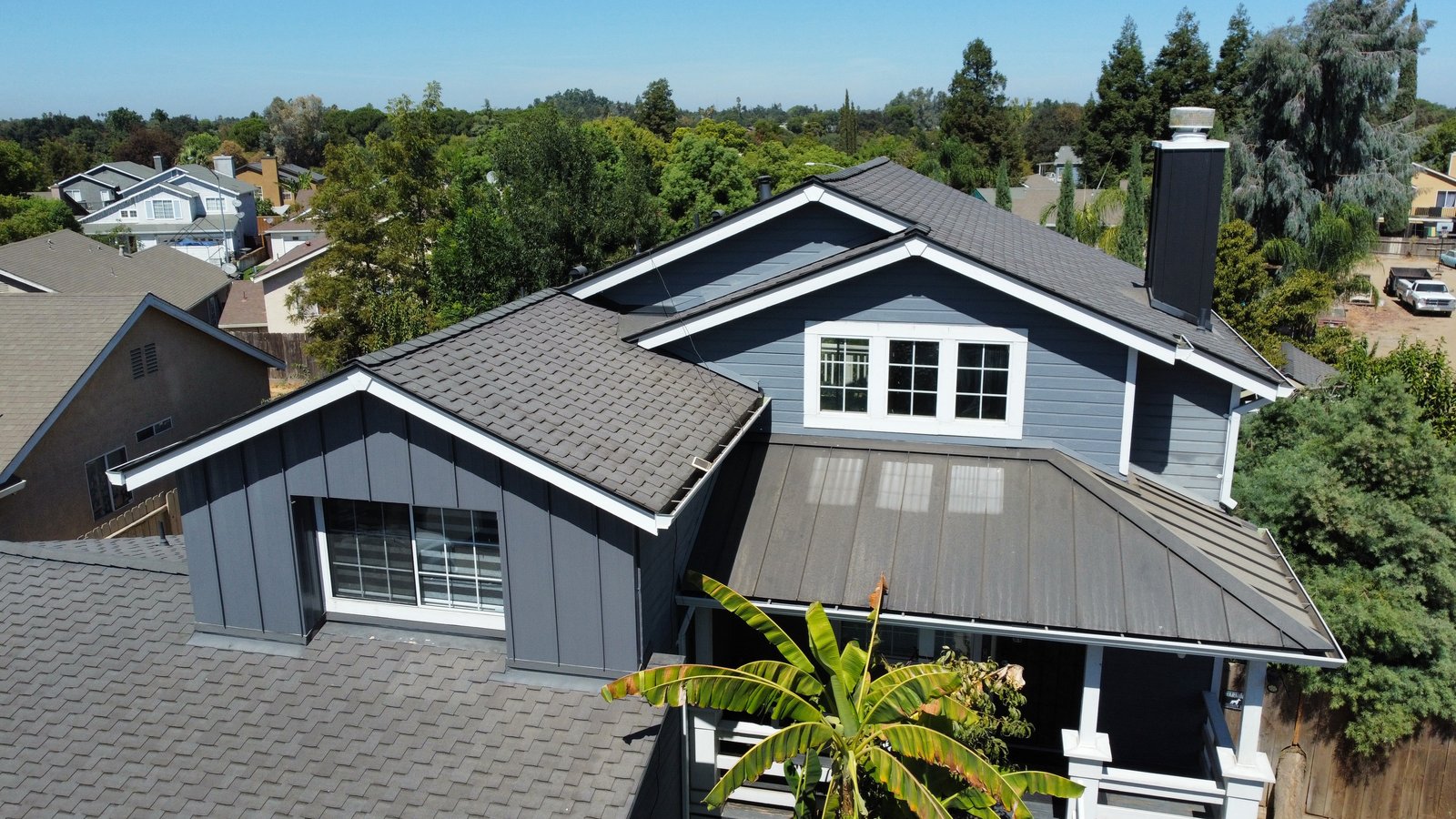
Many Central Valley homes keep asphalt on the main field and use standing seam as a porch or entry accent—different products, one weather plane.
That mix is honest and common. It still requires clean transitions, matching color intent, and underlayment under the metal sectionnot a thin decorative “metal look” without a real panel system.
Repair vs full metal scope
Some metal issues are local: a damaged panel face, a failed penetration flashing, or a short accent plane that needs re-panel work while the main asphalt field stays.
The conversation widens when multiple planes are at end of life, when heat-aged asphalt plus recurring leaks point to a full re-roof decision—see Repair or replace? How we decide on a Modesto roofor when low-slope geometry makes shingles a poor long-term fit. Aim for the smallest scope that solves the documented problemnot caulk on a failed seam as a permanent fix, and not a default whole-house metal tear-off when a porch accent or local flashing repair is enough.
What Modesto homeowners can safely notice from the ground
Stay off steep or hot metal roofs unless you are trained and insured. From the yard, binoculars, or clear contractor photos, useful cues include:
- Raised vertical seams running eave-to-ridge on charcoal or colored panels (standing seam look vs flat corrugated sheets)
- Oil-canning (visible waviness in wide flat panel areas)—ask whether the profile and clip system match the span; not every wave is a leak
- Skylight curbs and flashings that look incomplete, open, or heavily caulked instead of integrated
- Accent planes (porch/entry) in metal under an asphalt main field—transitions at walls and step flashings deserve a close look in photos
- Underlayment showing on an active job—normal during dry-in; ask what product and how penetrations will close
You usually will not see clips or fasteners once seams are locked—that is normal. What you can ask for are photos of underlayment, curb flashing, and seam details while the roof is open.
Before fall: a practical metal checklist
- Decide whether you are asking about a full metal system or a metal accentdifferent scopes and budgets
- Ask what underlayment goes under the panels and how skylights/pipes will flash into the metal field
- Ask for photos of seams, curbs, and transitions—not only the finished street view
- Remember eaves, valleys, and attic airflow still matter on metal homes too
- Use Get a Quick Quote if you want Legend Roofing Company Inc to document the roof in clear photos and plain language
Standing seam is a system. Heat is why Modesto asks early.
Standing seam metal gives Central Valley homes a durable panel surface when the scope fits—full roof or porch accent—backed by dry-in and penetration flashing done as part of the system. If you are in Modesto, Ceres, Riverbank, Oakdale, or nearby towns, Legend Roofing Company Inc (CSLB #1067374 · GAF Master Elite) can document the roof and explain metal options in plain language. More local context: Roofing Modesto.
Legend Roofing Company Inc · 4400 Gomes Rd, Modesto, CA 95357 (669) 294-1760 · 7am5pm daily · CSLB #1067374 GAF Master Elite