
Roof Vents Before Fall: Why Modesto Attics Still Need Airflow
After months of Central Valley heat, Modesto attics still need a path for hot air to leave and cooler air to enter. Here is how common roof vents work—and what to check before fall without walking a steep roof.
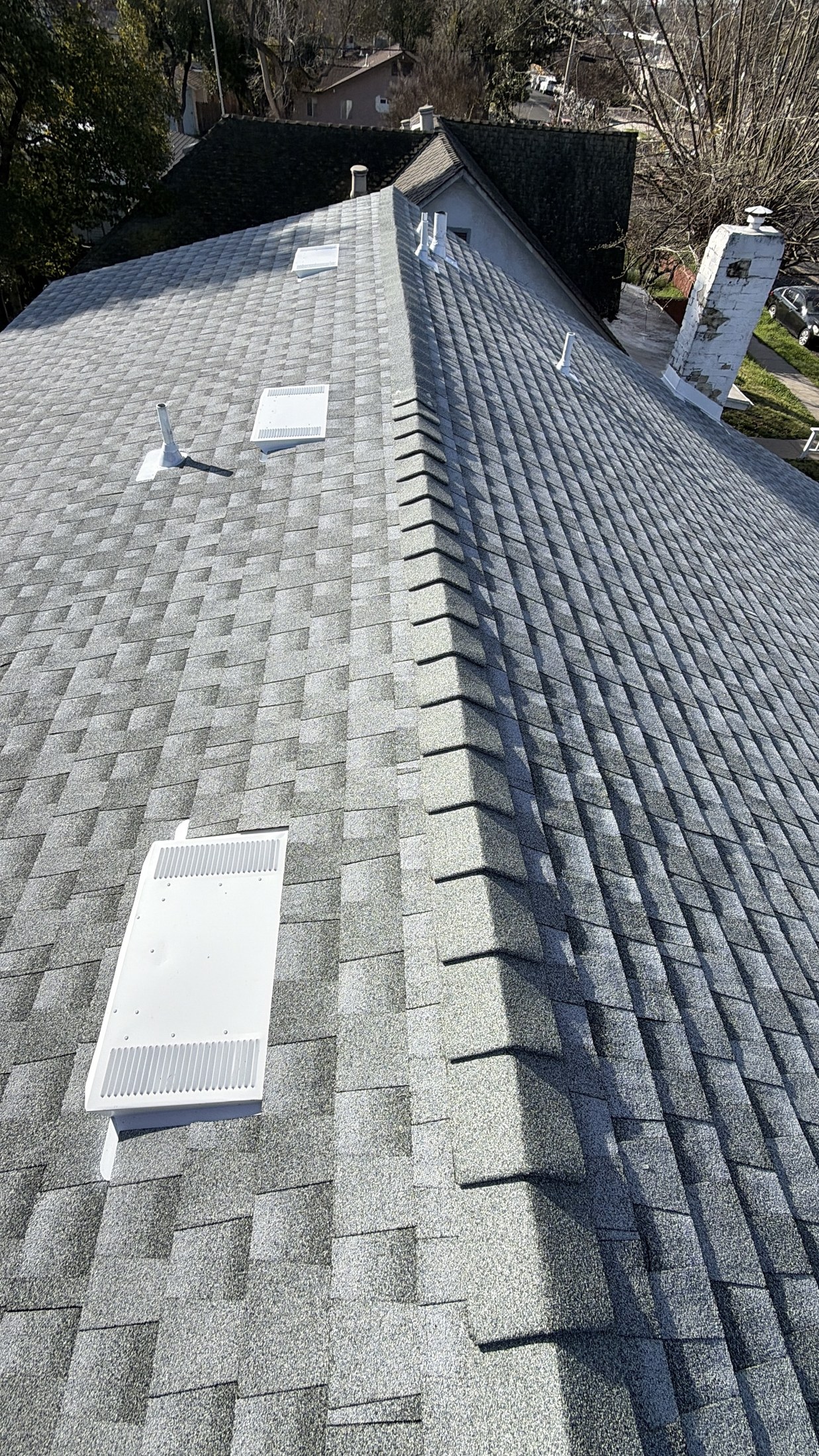
Finished gray asphalt ridge with white off-ridge (box) vents and pipe boots—common exhaust hardware on Central Valley homes.
After a long Central Valley summer, most homeowners think first about shingles that look tired or a chimney that stained after the last wind. The attic above those shingles still matters. Hot air that has nowhere to leave keeps working on the underside of the roof deck and the shingle field. When cooler, damper nights return to Modesto, Ceres, Riverbank, or Oakdale, that same attic needs a clean path for moisture-laden air to move—not a sealed box.
This guide is about roof ventilation hardware and balanced attic airflow: off-ridge (box) vents, ridge-vent systems, and intake at the eaves. It is distinct from ridge-cap shingles (the weather finish at the peak), from pipe boots and sun tunnels (penetrations that leak), and from ice-and-water membrane at eaves (edge waterproofing).
What “balanced” attic ventilation means
A healthy attic usually needs two things working together:
- Exhaust high on the roof — hot air leaving through ridge vents, off-ridge box vents, or other approved exhaust vents
- Intake low at the eaves — cooler outside air entering through soffit or eave vents so the attic is not starving for make-up air
Exhaust without intake (or the reverse) is why some roofs “have vents” but still feel oven-hot in August or show condensation stains after the first cool fog. The goal is a continuous path, not more random holes.
Off-ridge (box) vents vs continuous ridge vents
On many Modesto-area asphalt roofs we document, white rectangular off-ridge vents (often called box vents) sit on the upper slopes near the ridge. They are discrete exhaust openings with louvers, flashed into the shingle field. A finished gray ridge with several box vents along the peak is a common Central Valley pattern—not every home uses a continuous ridge vent under the ridge caps.
Continuous ridge vents run along the peak under the ridge-cap shingles, exhausting along a long slot. They are a different product choice. Ridge-cap shingles still finish the weather surface either way—see Ridge Caps on a Modesto Roof Replacement for the cap product and peak finish. This post is about the air path, not the decorative cap.
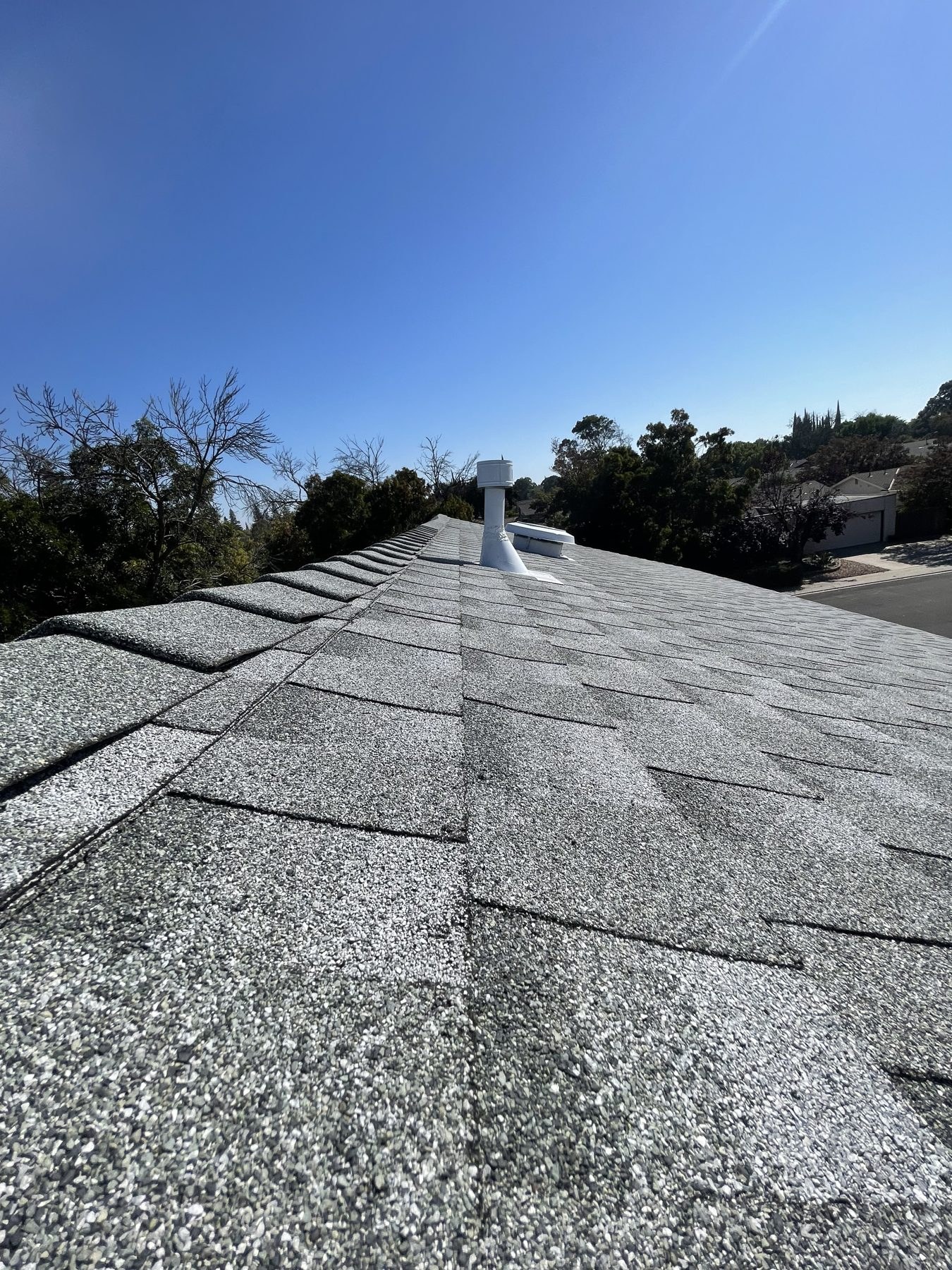
Ridge-cap courses finish the peak; nearby, a round attic vent is another exhaust path—different shape, same job of letting hot attic air leave.
Why summer heat makes fall the right time to look
Central Valley summers push attic temperatures hard. Heat that cannot exhaust ages asphalt shingles from below as well as from the sun above—see What Central Valley Heat Does to Asphalt Shingles—and stresses underlayment and deck moisture cycles—see What's Under Your Shingles?.
Fall is when cooler nights return and moisture shows up, while valleys and eaves still deserve their own attention (Roof Valleys Before Fall Rain, Ice & Water Shield Before Fall Rain).
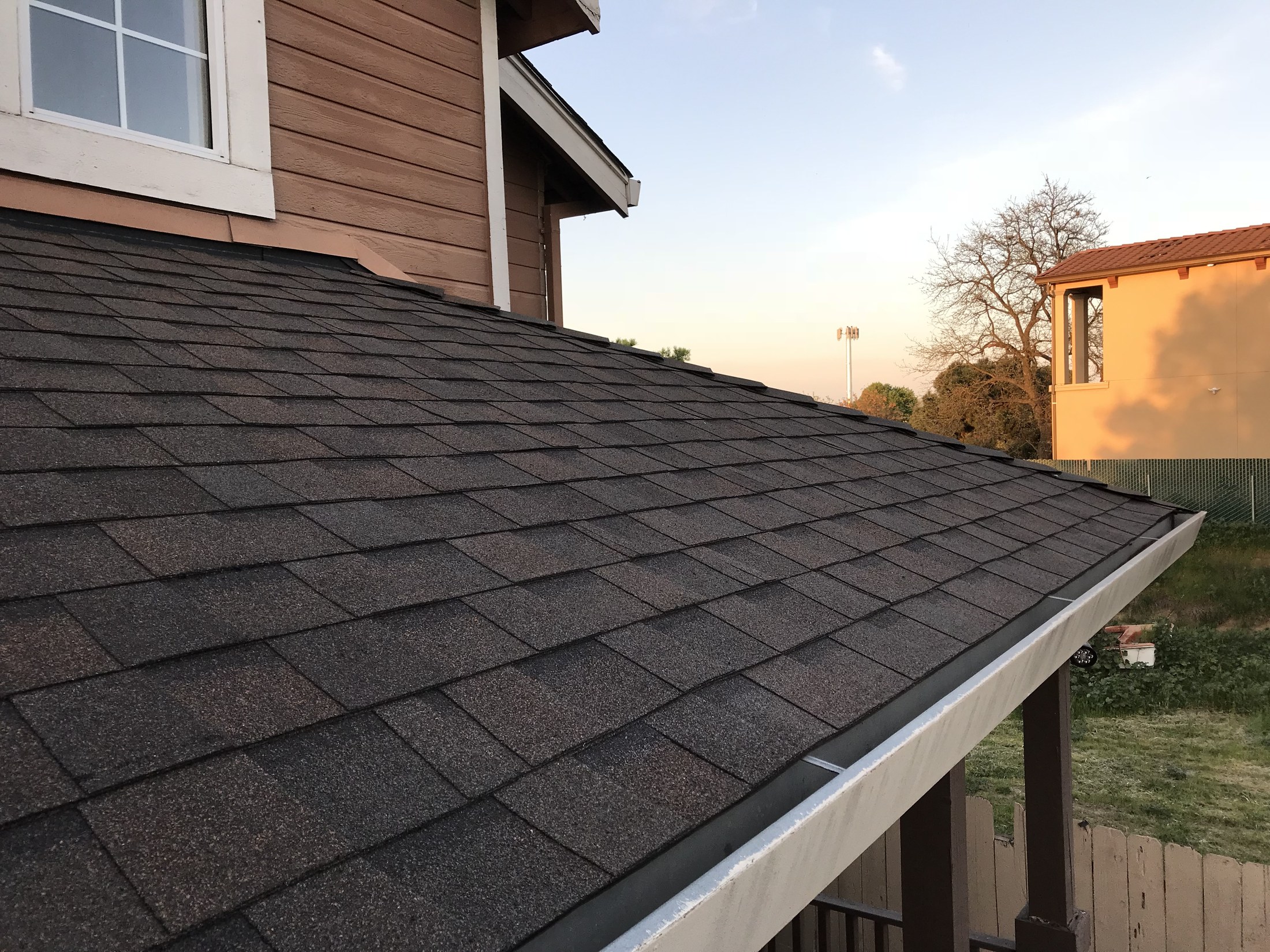
Balanced ventilation needs intake as well as exhaust. From the yard you often see the eave and gutter line—where soffit or eave intake usually lives—not the attic itself.
What Modesto homeowners can safely notice from the ground
Stay off wet or steep roofs unless you are trained and insured. From the yard, binoculars, or clear contractor photos, useful cues include:
- Blocked or painted-over soffit vents under the eaves — intake starved
- Missing, crushed, or heavily debris-filled box vents near the ridge
- Daylight or gaps at ridge caps that look like a failed vent slot rather than a normal cap shadow (ask for photos; do not probe from a ladder in wind)
- Attic that feels dramatically hotter than outside on a still evening after a 95°F day — exhaust may be weak
- Insulation stuffed against soffit baffles (if you can see from the attic hatch) — intake choked
You usually will not see a continuous ridge vent from the street once caps are on—that is normal. What you can ask for, when a contractor opens a ridge or attic, are photos of the vent slot, baffles, and clear intake path.
Repair vs when ventilation is part of a larger scope
Many ventilation problems are local: clear soffit intake, replace a damaged box vent and flashing, add baffles so insulation does not block the eave path, or repair a short run of ridge vent when that peak is already open for other work.
The conversation widens when the attic shows widespread heat damage, when multiple exhaust vents are undersized for the roof footprint, or when a full re-roof is already planned and the honest scope includes correcting both intake and exhaust while the deck is open. Aim for the smallest scope that restores balance—not caulk on a crushed vent hood, and not a default tear-off when intake clearing would solve it. See Repair or replace? How we decide on a Modesto roof.
Before the first cool, damp nights: a practical checklist
- Expect attic heat and moisture to show up after dry summers—plan inspection attention on vents and soffits, not only on shingle color
- Ask whether the system has both exhaust and intake—not exhaust alone
- Ask for photos of box vents, ridge-vent slots (if used), and soffit baffles when the attic or ridge is opened
- Keep gutters and eaves clear so debris does not also choke intake at the fascia line
- Do not seal an attic “tight” for energy savings without a ventilation plan—roofs and attics are not conditioned rooms
- Use Get a Quick Quote if you want Legend Roofing Company Inc to document vents and soffits in clear photos and plain language
Hot attics age roofs from below. Airflow is the quiet fix.
Balanced attic ventilation gives Modesto roofs a way to shed summer heat and move moisture when cooler nights return. Box vents, ridge vents, and eave intake are different hardware with one job: keep air moving. If you are in Modesto, Ceres, Riverbank, Oakdale, or nearby Central Valley towns, Legend Roofing Company Inc (CSLB #1067374 · GAF Master Elite) can inspect the ventilation path and explain what we find before fall.
Legend Roofing Company Inc · 4400 Gomes Rd, Modesto, CA 95357 · (669) 294-1760 · 7am–5pm daily · CSLB #1067374 · GAF Master Elite