
Roof Valleys Before Fall Rain: How Water Leaves a Modesto Shingle Roof
Roof valleys are where two slopes meet and water runs hardest. Here is how metal valley flashing plus underlayment dry-in protect Modesto asphalt-shingle roofs before fall storms.
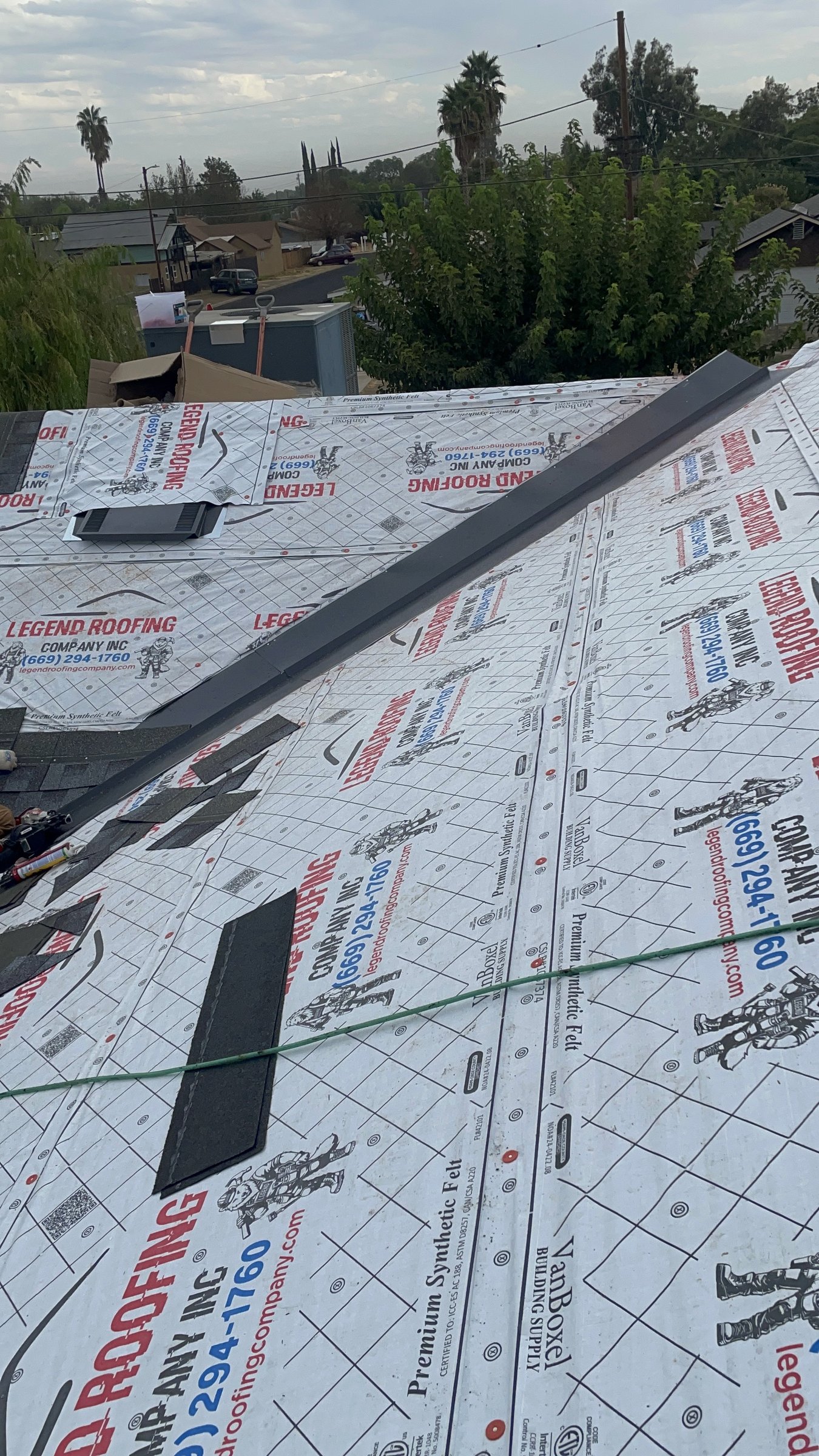
Metal valley flashing seated where two slopes meet—Legend underlayment already down, first shingle courses starting along the metal edge.
On an asphalt-shingle roof, a valley is where two roof slopes meet and form a channel. Rain and winter storm water do not spread evenly across that channel—they concentrate. That is why valleys matter more than a quiet field of shingles when the first Modesto fall storms arrive after a long Central Valley dry season.
This guide is about asphalt and architectural shingle valleys: metal valley flashing plus underlayment dry-in (including products like GAF FeltBuster and Polyglass self-adhered membrane). It is a different system from clay or concrete tile valleys, where debris and soft deck under the tiles are often the story—see our related Ripon tile-valley education when you want that sequence. Here we stay with Modesto shingle roofs and how water is supposed to leave the building.
What a roof valley is
Picture two planes of roof meeting like an open book. The crease is the valley. Gravity pulls water from both slopes into that crease, then down toward the eaves or a lower roof. On a finished asphalt system you usually see shingle courses meeting at a metal strip, or a woven shingle pattern, with the metal (when used) acting as a smooth, durable channel.
From the street, valleys can look like a simple color break. Functionally they are one of the busiest water paths on the roof. Gutters, downspouts, and yard drainage only see what the valley successfully delivers. If the valley detail is tired, water can leave the intended path and find underlayment seams, nail holes, or soft deck long before the open slopes show trouble.
Why valleys concentrate water
Sheet flow on a quiet slope moves slowly and spreads. In a valley, two flows merge. Leaves, pine needles, and dust also collect there—especially after months of Central Valley heat and wind with little rain to flush the channel. When the first real storm hits Modesto, Ceres, Riverbank, or nearby towns, that concentrated volume tests:
- Whether the metal is continuous and seated correctly
- Whether underlayment and any self-adhered membrane still form a dry-in layer under and beside the metal
- Whether shingle edges along the valley are cut and layered to shed into the channel—not lift or curl away from it
Concentration is normal physics, not a defect by itself. The detail has to be built for that load.
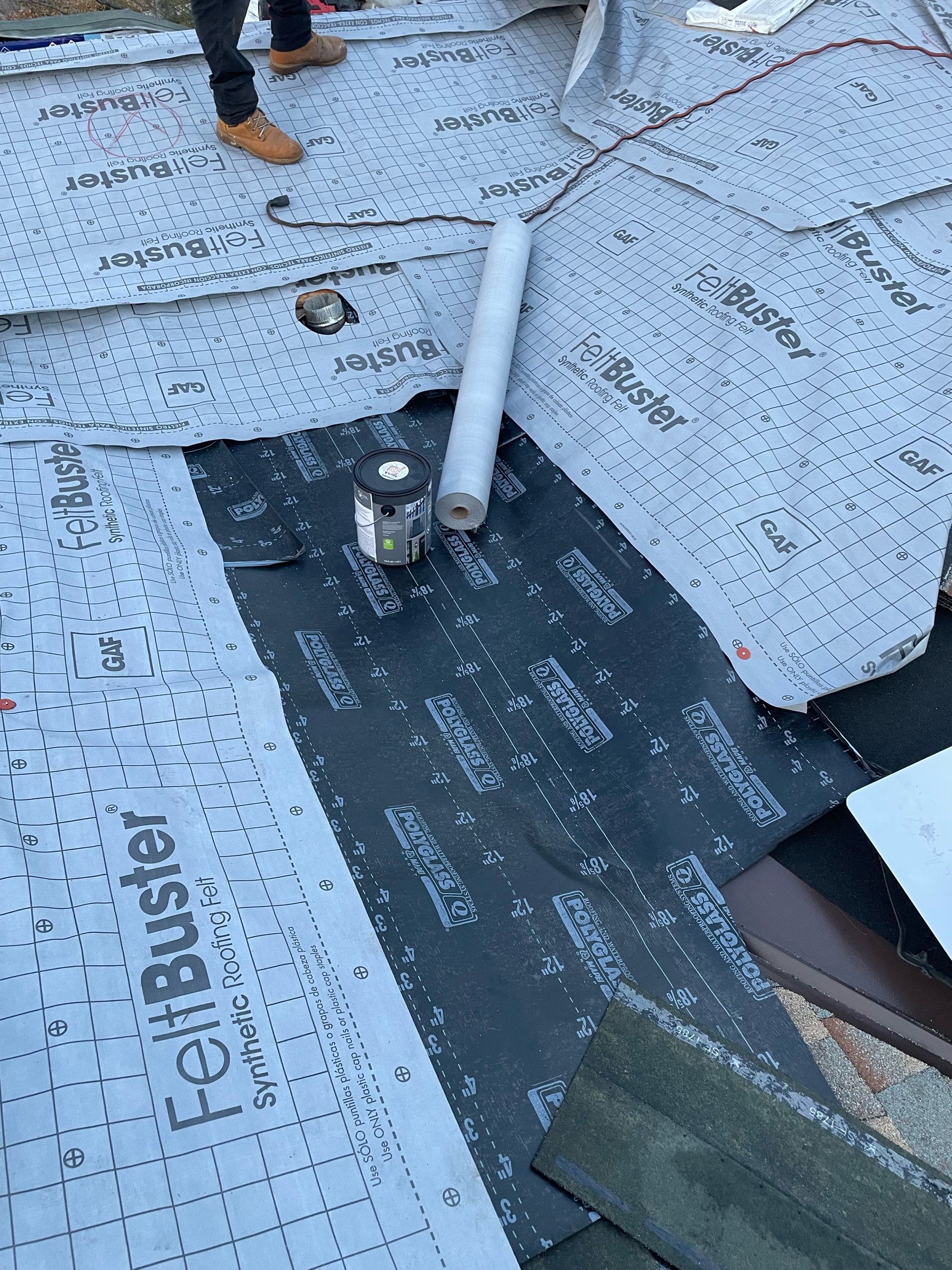
Dry-in layers at the valley: FeltBuster field underlayment plus Polyglass membrane over the metal—water control before shingles return.
How metal valley + underlayment dry-in work on asphalt roofs
A common, durable approach on architectural shingle roofs is metal valley flashing plus a dry-in stack before the finished shingles go on.
Metal valley: A formed metal strip sits in the crease. It gives water a smooth path and protects the wood deck from abrasion where shingles would otherwise meet in a high-wear zone. Shingle courses are woven or cut to the metal so water stays on the weather surface and runs the channel.
Underlayment dry-in: Before or as the metal is integrated, field underlayment covers the deck. On Modesto jobs we document, that often includes a synthetic felt such as GAF FeltBuster across the planes, with a heavier self-adhered membrane such as Polyglass reinforcing the valley line itself. Those layers are the backup if wind-driven rain or a temporary opening challenges the shingles. They are not a substitute for correct metal and shingle layering—they work with them.
On a recent Modesto replacement, Legend underlayment covered the field while dark metal sat in the valley and the first shingle courses began along the edge. Closer shots show FeltBuster and Polyglass over the metal, then Copper Canyon courses nailed at the valley with Grand Sequoia bundles staged for the remaining work—real job photos, not stock.
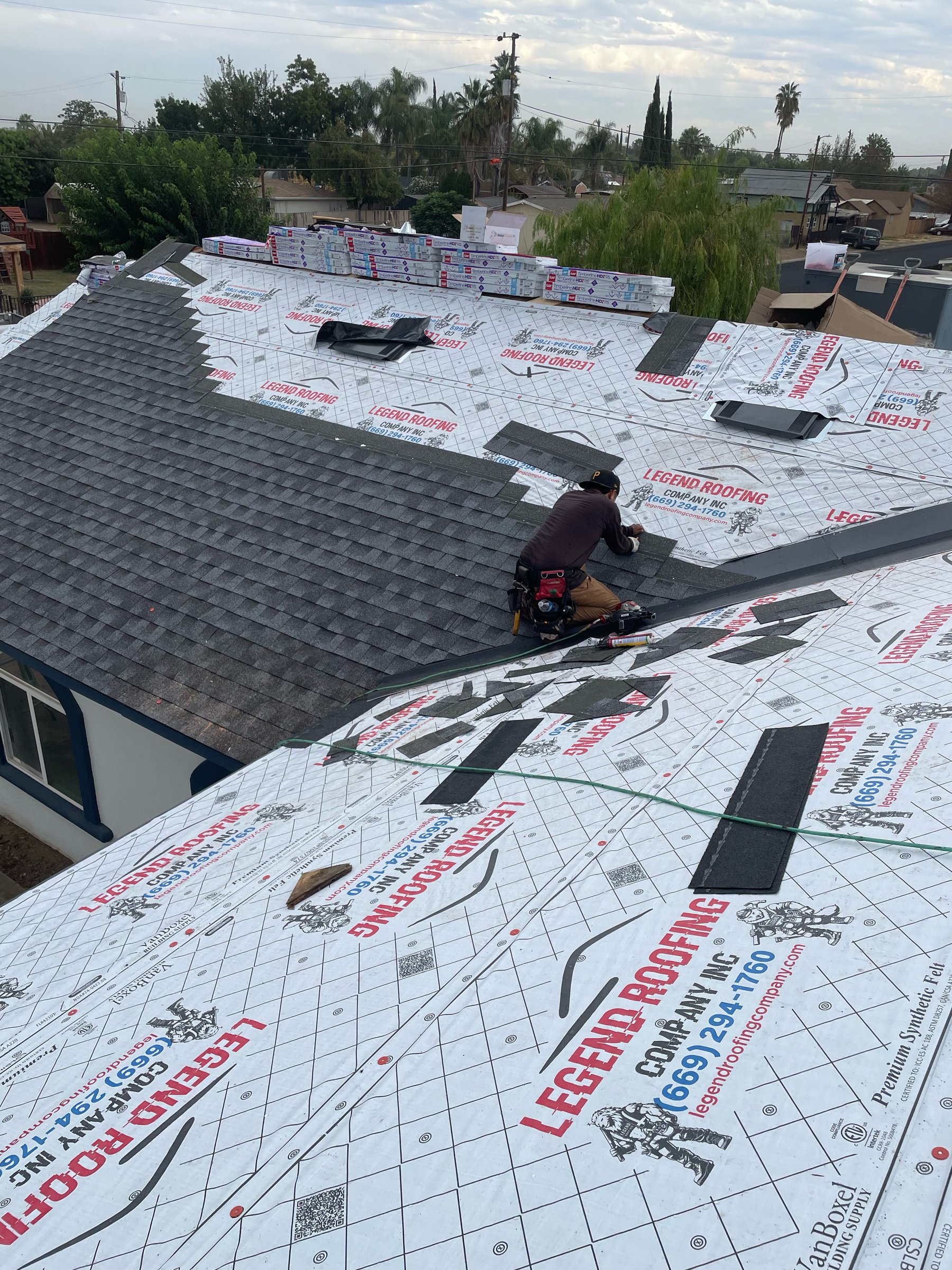
Shingles going on along the valley after dry-in—architectural courses woven to shed into the metal channel.
Same Modesto valley system mid-install—metal in the channel, branded underlayment across the field, bundles staged for the remaining courses.
What Modesto homeowners can safely notice from the ground
Stay off a wet or steep roof unless you are trained and insured. From the yard, binoculars, or clear contractor photos, useful cues before fall rain include:
- Debris packed in the valley — organic buildup that holds moisture against metal and shingle edges
- Rusted, lifted, or dented metal — especially at seams or where fasteners show daylight
- Curling, cracked, or missing shingles along the valley edge — water can slip under a lifted course
- Stains on ceilings or interior walls under known valley lines after storm events
- Uneven or “patched” looking valley lines from repeated caulk-only repairs that do not restore metal and underlayment as a system
None of these alone diagnose the whole roof. They are honest reasons to ask for roof-level photos—not only a drive-by opinion. For underlayment after wood and flashings are right, see What's Under Your Shingles? Why Underlayment Matters in Modesto Heat.
When repair vs replacement enters the conversation
Many valley problems are local repairs: clear debris, replace tired metal, renew underlayment or self-adhered membrane in the channel, and re-cut shingle edges so they shed correctly. That is often enough when the surrounding field shingles and deck are still serviceable.
The conversation widens when soft deck spreads beyond the valley, when multiple valleys and penetrations fail together after heat, or when the asphalt system is at end of life. Aim for the smallest honest scope that keeps water in the channel—not caulk-only, and not a default tear-off when a valley rebuild would solve it. See Repair or replace? How we decide on a Modesto roof. Tile valleys with debris and rot are a different sequence—see When a Tile Valley Goes Soft.
Before the first fall storms: a practical checklist
- Expect valleys to carry more water than open slopes—plan inspection attention there
- Ask whether the scope includes metal valley and underlayment dry-in as a system, not sealant alone
- Ask for photos of dry-in layers (synthetic felt / self-adhered membrane) when the valley is opened
- Clear safe ground-level debris from gutters that receive valley discharge so water can leave the roof
- Use Get a Quick Quote if you want Legend Roofing Company Inc to document your valleys in clear photos and plain language
Water concentrates in the valley. The detail has to match that load.
Asphalt-shingle valleys are primary drainage paths—not decorative lines. Metal valley flashing plus FeltBuster/Polyglass-style dry-in gives Modesto roofs a controlled way to shed fall rain. If you are in Modesto, Ceres, Riverbank, or nearby Central Valley towns, Legend Roofing Company Inc (CSLB #1067374 · GAF Master Elite) can inspect the system and explain what we find before the next storm.
Legend Roofing Company Inc · 4400 Gomes Rd, Modesto, CA 95357 · (669) 294-1760 · 7am–5pm daily · CSLB #1067374 · GAF Master Elite