
TPO Flat Roofs in Modesto: Seams, Drains and Flashings Before the Rain
A flat roof doesn’t shed water the way a shingle roof does, so it lives or dies by its seams, its drainage and every spot where something pokes through. Here is how a TPO low-slope roof keeps water out, shown on a real Legend Roofing job.
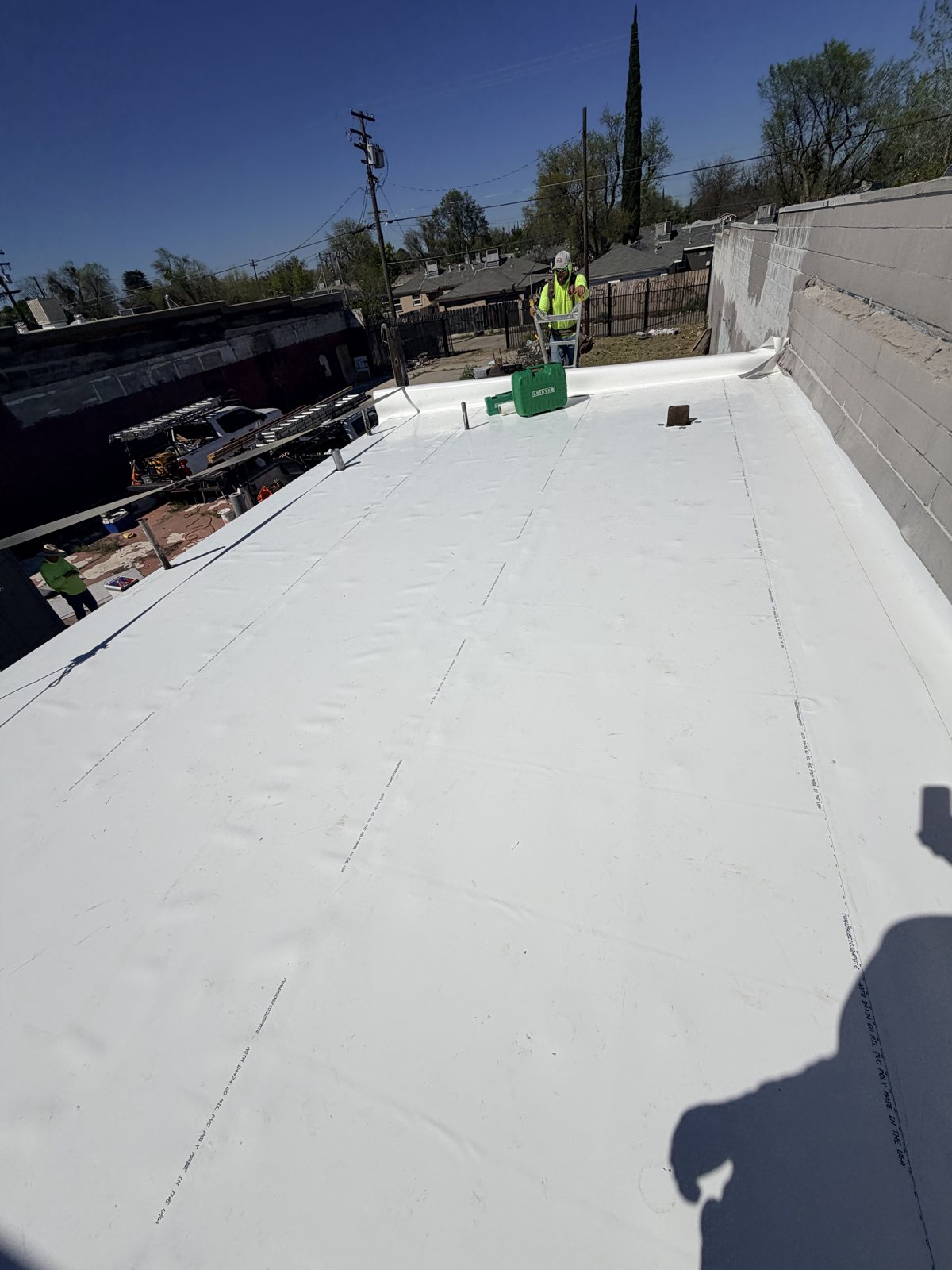
A white TPO membrane going down on a low-slope roof. The green case is the hot-air welder the crew uses to fuse the seams.
Plenty of buildings around Modesto and the Central Valley have a section of roof that’s nearly flat: shops and offices, but also patio covers, porches, room additions and garages on homes. Those areas can’t take regular shingles, and they’re usually where a roof leak shows up first once the rain comes back.
This guide answers the questions we hear most about TPO, one of the most common membranes on low-slope roofs, using photos from a real Legend Roofing Company Inc low-slope job.
Why can’t a flat roof just get shingles?
Shingles work by overlapping, so gravity pulls water off before it can get under them. That needs pitch. Building codes generally don’t allow asphalt shingles below a 2-in-12 slope, and roofs between 2-in-12 and 4-in-12 need extra underlayment. Below that, water moves too slowly and can back up under the laps. A low-slope roof needs a continuous, watertight surface instead, and that’s what a membrane like TPO is.
What is TPO?
TPO (thermoplastic polyolefin) is a single-ply membrane that comes in wide rolls. Because it’s thermoplastic, its seams are joined with hot air: the welder softens the top and bottom sheets and fuses them into one piece, instead of relying on glue or tape. A properly welded seam is meant to be as watertight as the sheet itself.
TPO is commonly installed in white or other light colors, which reflect a lot of Central Valley sun. If your project needs to meet California’s Title 24 cool-roof rules, the exact product and color have to qualify for that building, so we check the ratings for each job rather than assume (more in our cool-roof guide).
How is the membrane held down?
TPO can be fully adhered, mechanically fastened or held down with ballast, depending on the building, the deck and the wind exposure. On a mechanically fastened roof like the one below, screws and round steel plates go in along the edge of each sheet. The next sheet overlaps those plates, and the overlap is welded closed, so no fastener is left exposed to the weather.
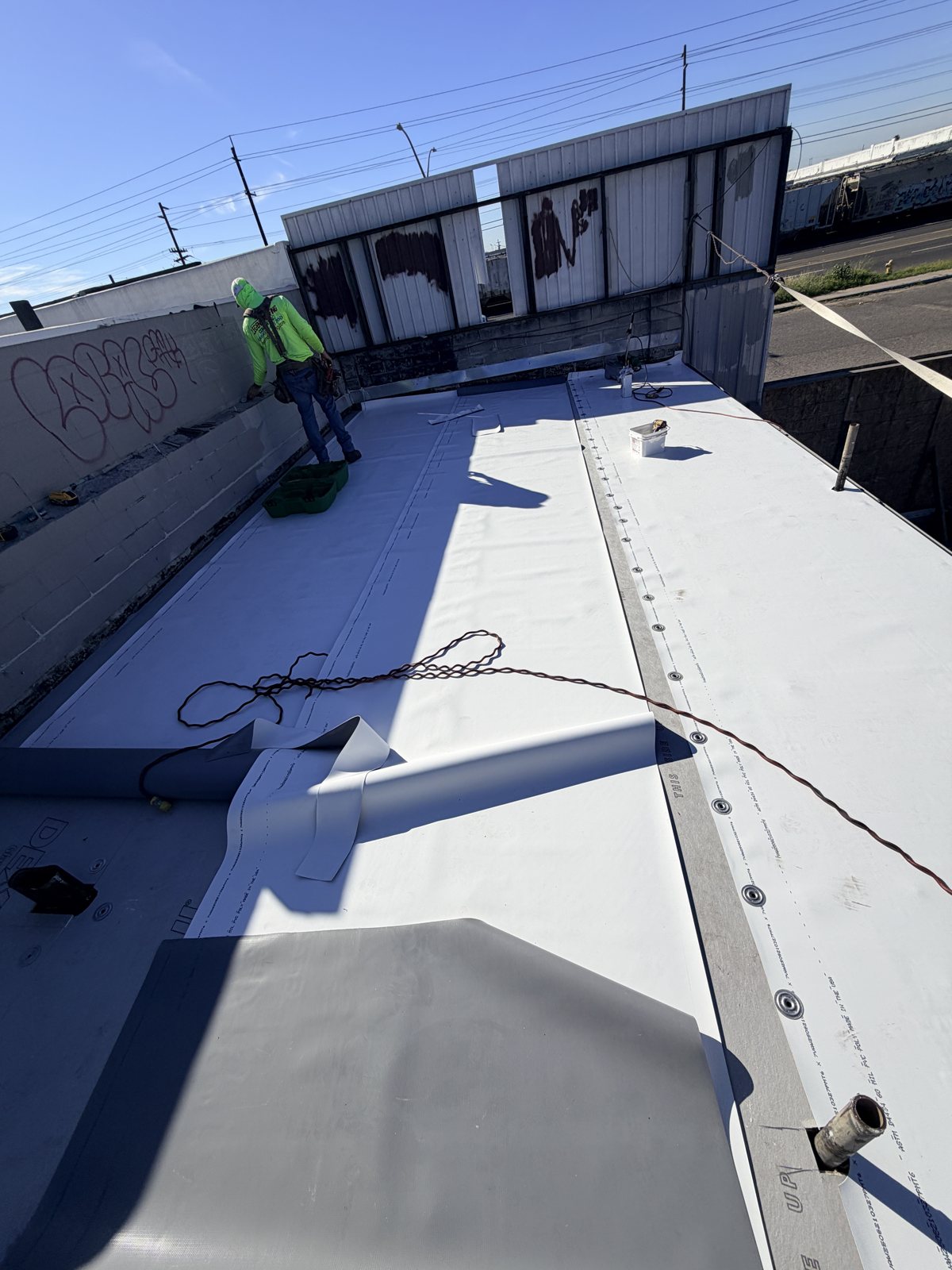
The row of round plates along the right-hand sheet holds it to the deck. The next sheet laps over those plates and gets welded along the printed line.
Where do flat roofs usually leak?
On a low-slope roof, the big open field of membrane is rarely the problem. Leaks tend to start at the details:
- Seams. A weld that was too cold, too hot or dirty can open up over time.
- Penetrations. Every pipe, vent and equipment stand is a hole in the roof. Each one needs its own boot or flashing tied into the membrane, the same idea as the pipe boots on a shingle roof.
- Walls and edges. Where the roof meets a parapet wall or a roof edge, the membrane has to turn up the wall and be finished at the top, or water gets behind it.
- Drainage. Codes generally call for at least a quarter inch of fall per foot on a single-ply roof. Water that’s still sitting a couple of days after a storm (ponding) is a sign the roof isn’t draining the way it should.
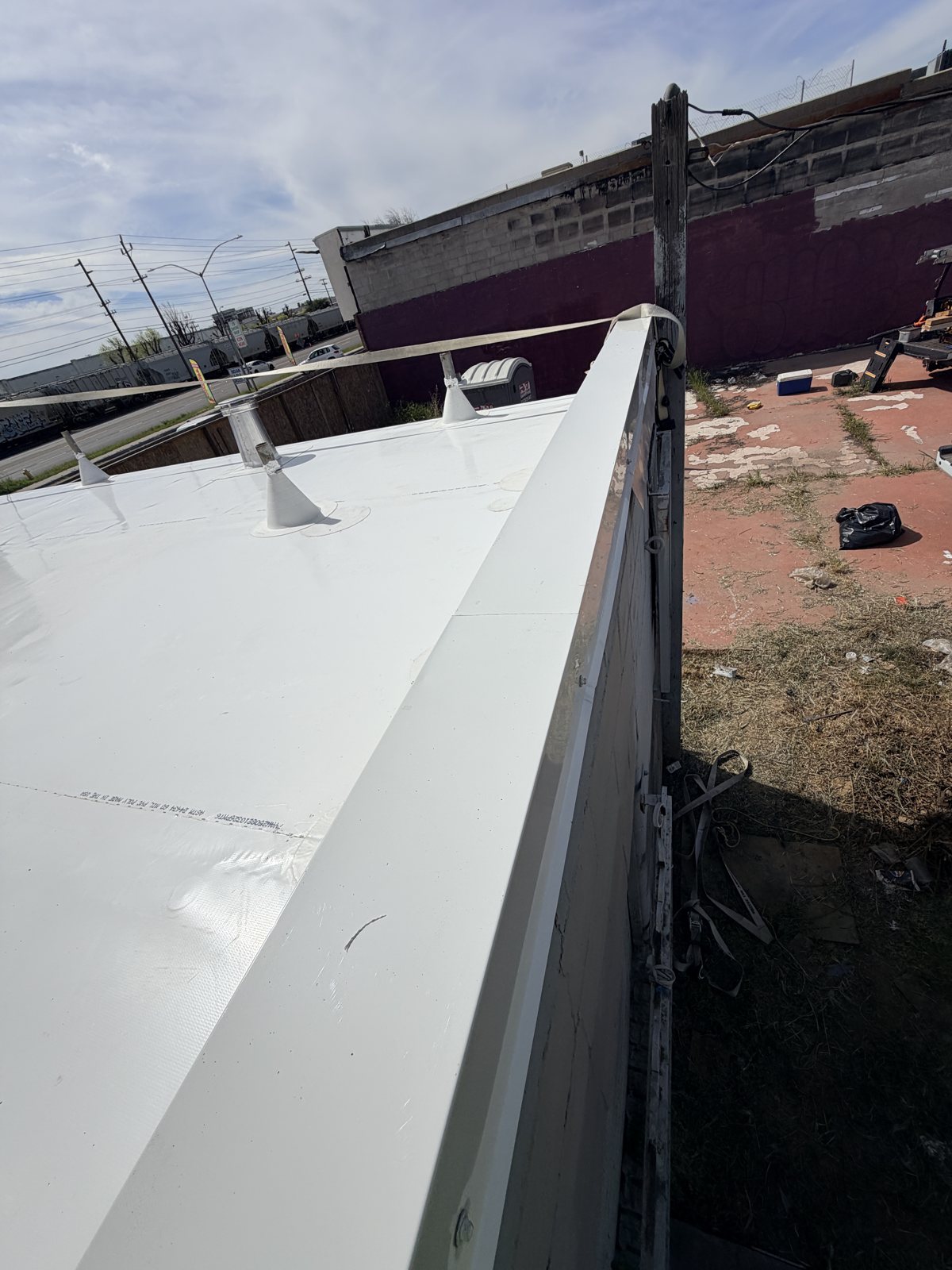
Two details from the same job: cone-shaped pipe boots around the pipes, and the membrane carried up and over the wall edge instead of stopping at the corner.
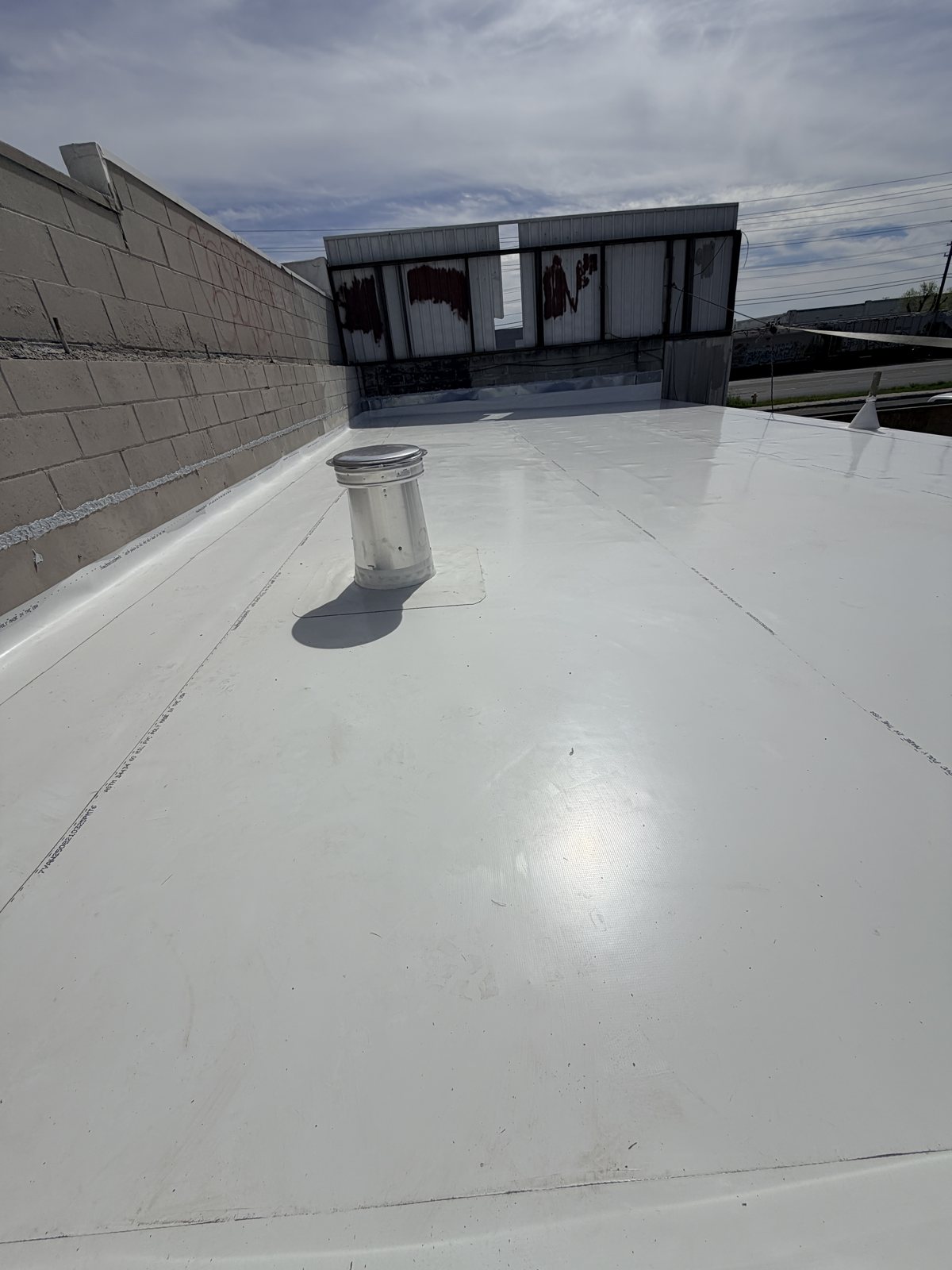
A vent stack flashed into the membrane at the base. You can also see the seam lines running across the roof.
A quick flat-roof check before the rain
If you can see your flat roof safely from a window, a ladder at the edge or a photo, look for these. Please don’t walk a roof you’re not comfortable on.
- Drains, scuppers and the gutters they feed are clear of leaves and debris (see gutters after a Central Valley summer).
- No dark stains or dirt rings where water has been sitting.
- Seams lie flat, with no lifted edges, wrinkles or open spots.
- Boots and flashings around pipes, vents and equipment are tight and uncracked.
- The membrane at walls and edges is still attached, not pulling away or loose at the top.
- Inside, no new ceiling stains under the flat section after the first storms.
Repair, recover or replace?
A failed seam or a bad boot can often be repaired. When the membrane itself is worn out, or water has gotten into the insulation or deck underneath, a repair won’t last and the roof needs a bigger fix. The only honest way to know is an inspection, and we put what we find in writing. Our repair or replace guide covers how we think about that call.
Questions to ask before you hire someone for a flat roof
- Which membrane and thickness are you proposing, and why for this building?
- How will it be attached: adhered, fastened or ballasted?
- How do you handle drainage if water ponds today?
- How will each pipe, vent, wall and edge be flashed?
- Does my project need to meet Title 24 cool-roof requirements, and does the product you’re quoting qualify?
Soft next step
If you have a flat section on a home, shop or office in Modesto or anywhere in the Central Valley and want it looked at before the rain, Get a Quick Quote via Contact or call (669) 294-1760. Learn more about our flat and low-slope roofing and commercial roofing.
Legend Roofing Company Inc · 4400 Gomes Rd, Modesto, CA 95357 · (669) 294-1760 · CSLB #1067374 · GAF Master Elite.