
Skip Sheathing to Solid Deck: What We Opened on a Turlock Roof
Many older Central Valley roofs were built with spaced wood boards, not a solid sheet. Here is what skip sheathing looks like on a Turlock replacement—and why we install solid deck before underlayment and shingles.
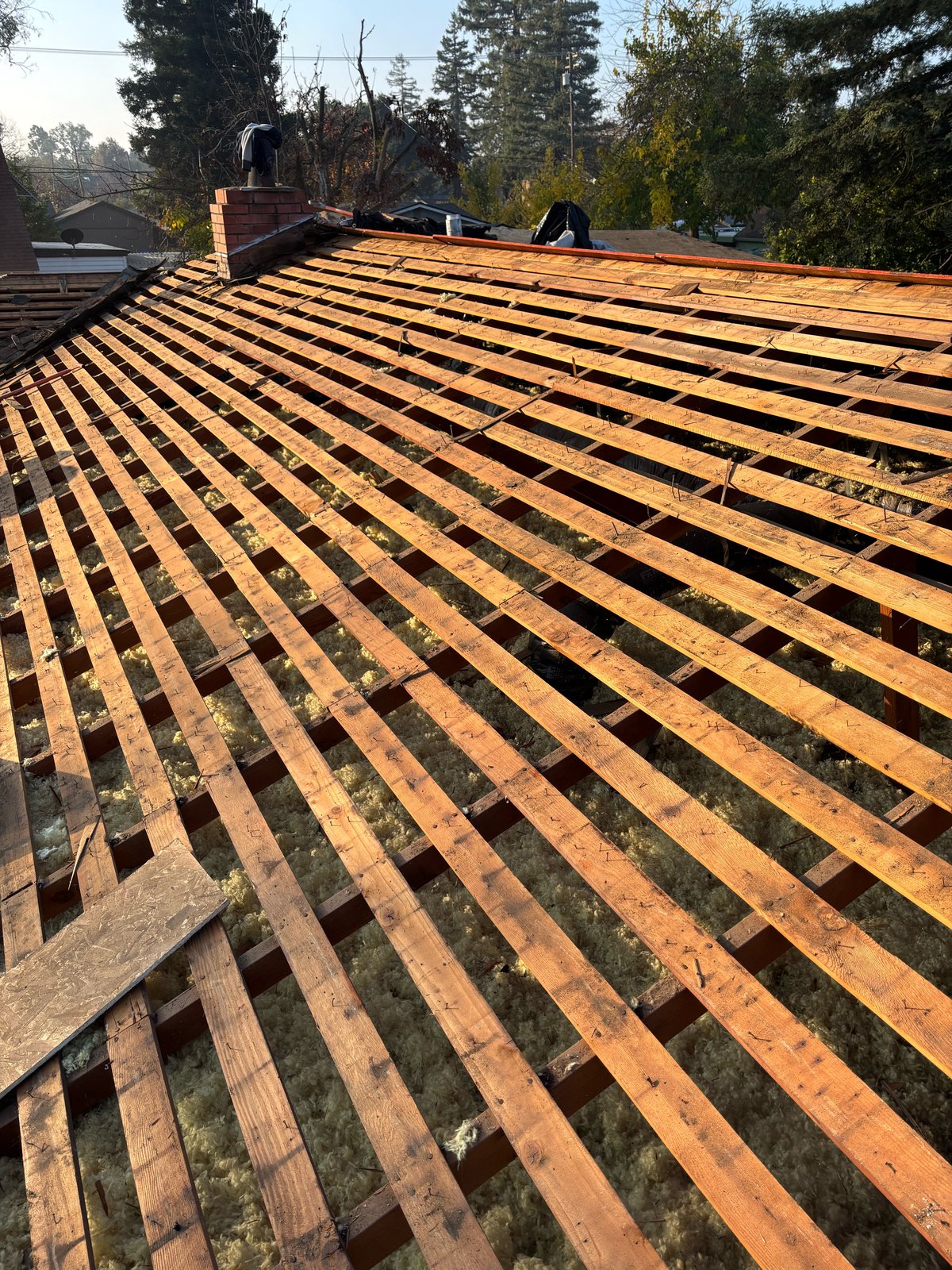
Skip sheathing with insulation showing between the boards—and the start of solid OSB so the new roof sits on a continuous deck.
If your house was built when wood shakes or older asphalt systems were common in the Central Valley, the deck” under the roof may not be a continuous sheet. Many older roofs used skip sheathing—spaced boards with gaps between them—so the attic could breathe under shakes.
Modern asphalt shingles need a solid nailing surface. On a recent Turlock roof replacement, we opened that older structure: tear-off down to spaced boards and open framing, then solid OSB over the skip before underlayment and new shingles. This guide explains what skip sheathing is, why it shows up on Central Valley tear-offs, what solid decking changes, and what homeowners in Turlock, Modesto, and nearby towns should ask before a replacement.
What skip sheathing is
Skip sheathing (sometimes called spaced sheathing or skip decking) is a pattern of boards fastened across the rafters with intentional gaps. Historically it suited wood shakes and some older systems that wanted ventilation under the weather surface.
From the street you rarely see it. The shingles or shakes hide the pattern. The first clear view often arrives during a full tear-off, when the crew peels the weather surface and the spaced boardsor open rafters between themcome into view. Between those boards you may also see attic insulation, just as we documented on this Turlock job next to a brick chimney.
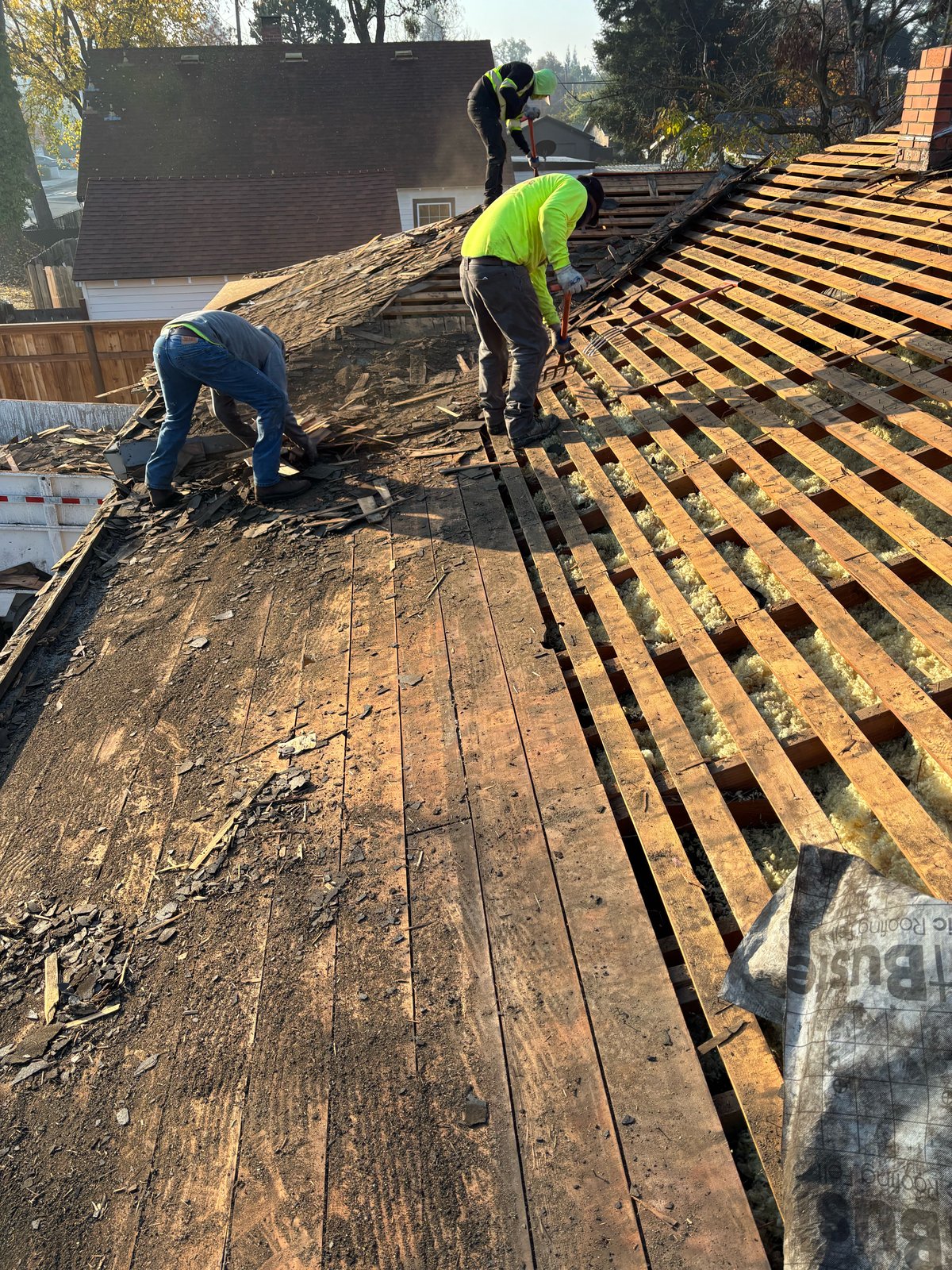
Mid tear-off: old shingles coming off, spaced boards still in place in places, and open framing where boards were lifted.
Why it still shows up on Central Valley tear-offs
Turlock, Modesto, and neighboring towns have plenty of mid-century and older houses. Many of those roofs were built or re-roofed in eras when spaced boards were normal. A later asphalt layer can sit on top of that older skeleton for years. Homeowners reasonably assume “there is a solid roof under there.” Often there is notthere is a lattice of boards that worked for the original system but is not the solid deck modern shingle manufacturers and current practice expect.
That does not mean every older roof is unsafe overnight. It means a quality replacement plan should say what happens when skip sheathing appears: leave gaps under new asphalt, or install a continuous solid deck first.
Tear-off: from shingles to boards to open framing
On this Turlock replacement, the tear-off phase showed the sequence clearly. Crews stripped aged shingles. In places, spaced boards remained. Where boards were lifted, rafters and yellow attic insulation showed through. A chimney stayed in the frame as a fixed penetration the new system still has to flash correctly later.
That mid-job view is educational on purpose. A replacement is not only new color on top.” It is a chance to see how the roof was built and whether the nailing surface matches what the new system needs. Debris goes to a trailer; the open structure is temporary and weather-sensitive—so dry-in planning matters once the old surface is gone.
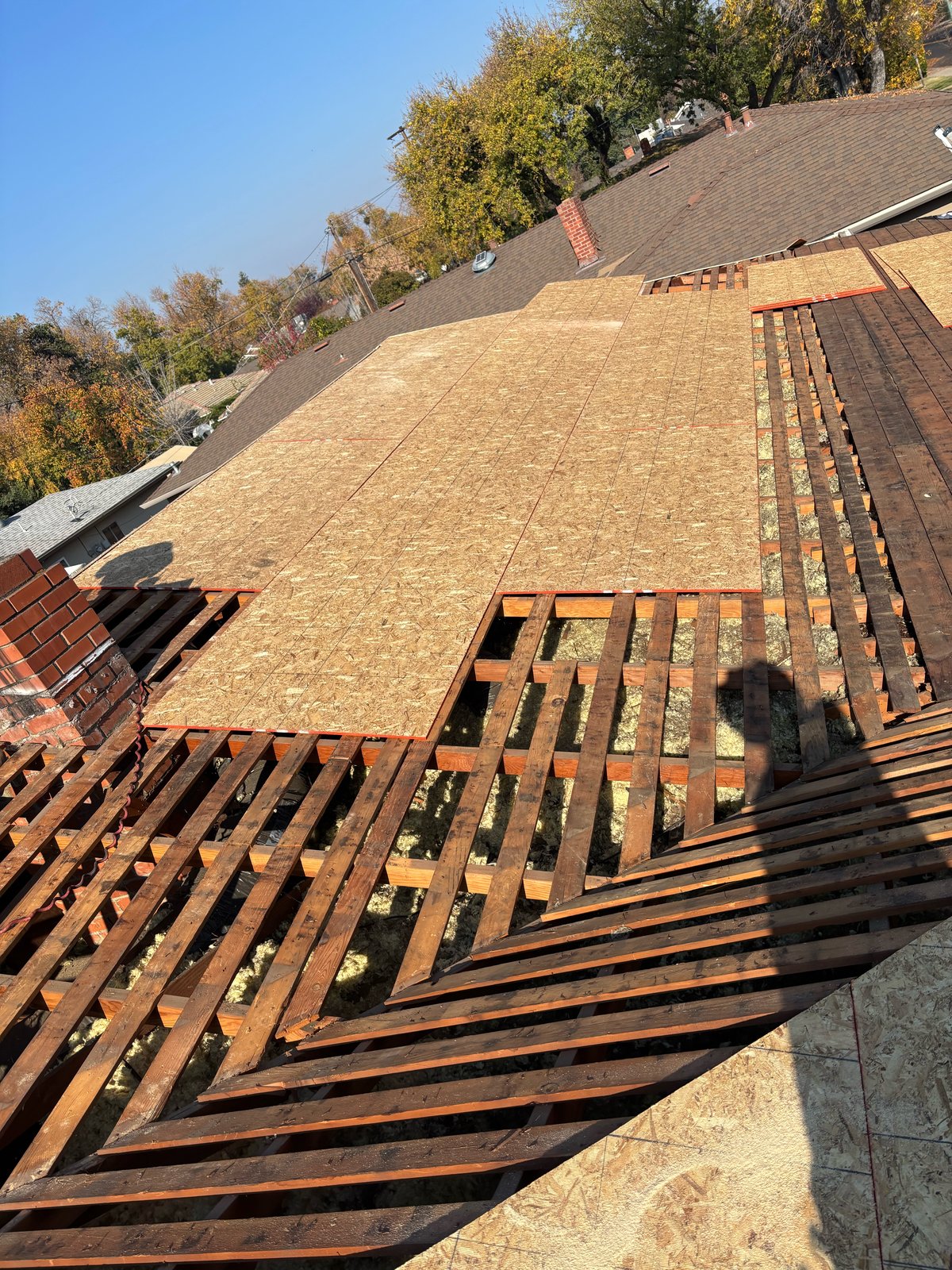
New OSB laid as a solid deck over the older spaced structurecontinuous wood before underlayment.
Installing solid OSB over skip sheathing
Once the old weather surface is off, the next structural conversation is the deck. On this job, sheets of OSB went down as a solid layer over the older spaced structure. Continuous wood gives asphalt shingles a consistent nailing plane, helps underlayment lie flat, and closes the open gaps that skip sheathing left between boards.
Solid decking is not the same topic as soft or rotten OSB that must be cut out and replaced because of moisture damage. Soft deck is a failure of wood that stayed wet too long. Skip sheathing is an older construction pattern that may still be sound as spaced boards—and still needs a solid sheet before modern shingles if that is the product going on. For underlayment after the wood is right, see What's Under Your Shingles? Why Underlayment Matters in Modesto Heat.
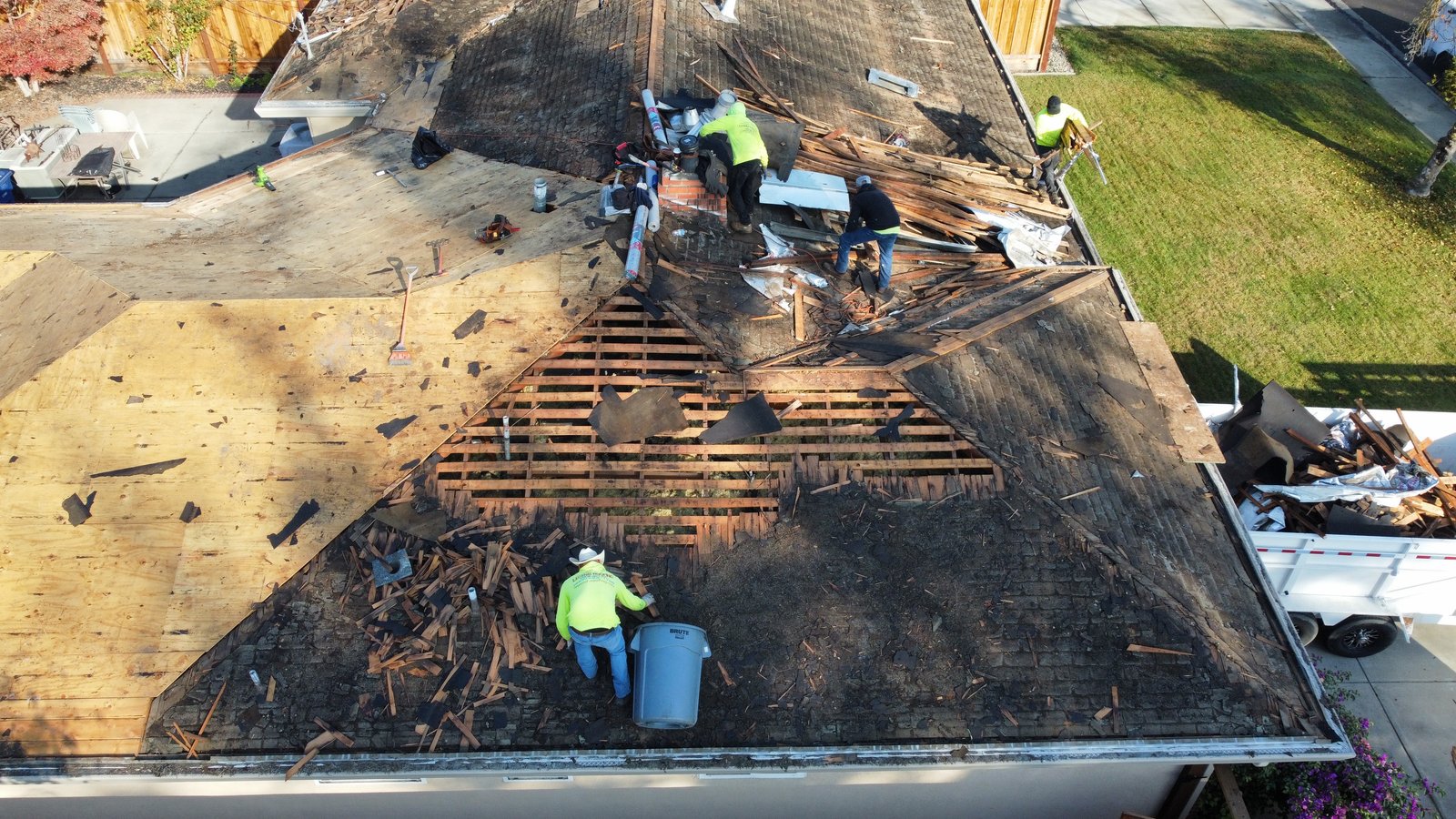
Same job from above: spaced boards still open in the center, solid deck already on one side, underlayment staged for the next step. Legend Roofing branding visible on a crew shirt.
Aerial view: one roof, both stages
From the drone, the same Turlock house showed both stages at once: spaced boards still open across part of the field, solid deck already on another wing, and rolls of underlayment staged at the ridge for the dry-in step. Legend Roofing crew in high-visibility shirts—branding kept in the photo—worked the transition in daylight.
That overhead shot is useful for homeowners deciding on a replacement. You can see that re-roof sometimes means more than shingles: it can mean building a modern deck on an older skeleton before the finished system goes on. Chimneys, valleys, and edges still get their own detailing afterward; the deck is the platform those details sit on.
What homeowners should ask before a replacement
Stay off an open tear-off roof. From the ground or through clear contractor photos, useful questions include:
- If skip sheathing appears, will you install solid OSB (or plywood) before underlayment and shingles?
- How will open framing and insulation be protected until dry-in?
- Will soft or damaged wood be replaced, not covered?
- How are chimneys, vents, and valleys detailed after the new deck is down?
- Can I see photos of the opened deck—not only the finished color?
An honest scope separates “shingle color choice” from what is under the shingles. For how we talk about repair versus full replacement in plain language, see Repair or replace? How we decide on a Modesto roof. Full replacements sit under our roof replacement work when the system is ready for a new start.
Before fall storms: a practical checklist
- Do not assume an older Central Valley roof has a solid sheet under the asphalt
- Ask what the crew will do if spaced boards appear during tear-off
- Expect solid decking before modern asphalt if that is the product specified
- Keep chimneys and other penetrations in the same conversation as the deck
- Use Get a Quick Quote if you want Legend Roofing Company Inc to document what is under your roof in clear photos and plain language
Spaced boards were common. Solid deck is the modern nailing surface.
Skip sheathing is not a mystery defect—it is how many older Central Valley roofs were built. On this Turlock replacement, the opened roof showed spaced boards, insulation between them, then solid OSB so the new system had a continuous deck. If you are in Turlock, Modesto, or elsewhere in the Valley and a replacement is on your list, Legend Roofing Company Inc can inspect the structure and explain what we find before shingles go back on.
Legend Roofing Company Inc · 4400 Gomes Rd, Modesto, CA 95357 · (669) 294-1760 · 7am–5pm daily · CSLB #1067374 · GAF Master Elite